← Back to Contract01 · PARTIES & AUTHORITY

Parties & authority

Does the person across the table actually have authority to contract?

Verify authority through documents and relationships, not impressions.

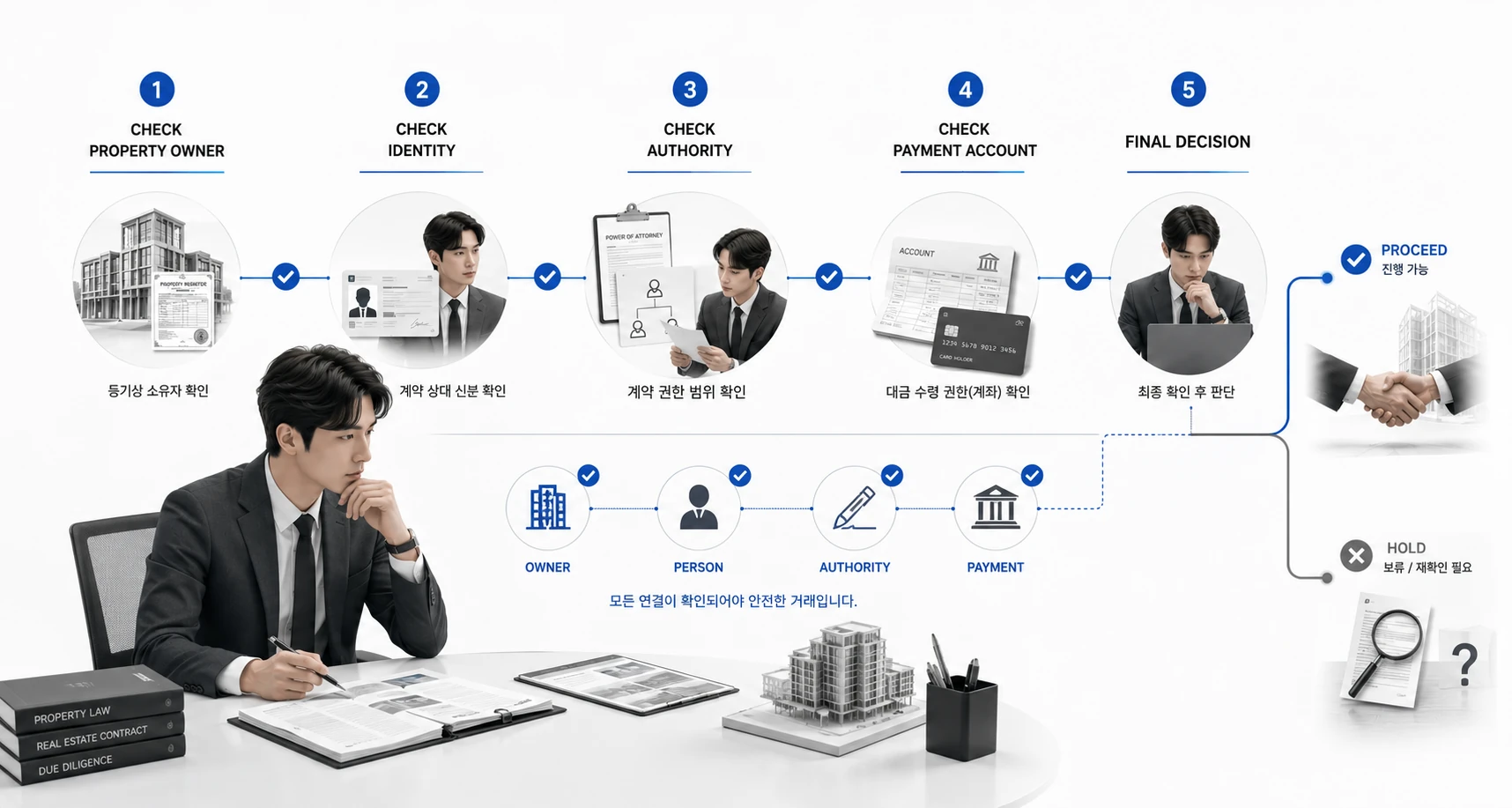
Overview graphic connecting owner, contracting party, signing authority and payment authority
FIELD GUIDE

Start by confirming who can actually make this transaction.

Verifying the contracting party does not end with checking an ID. The owner, the person signing, any agent authority, co-ownership structure, and the account receiving funds should all make sense within one transaction structure.

01

For a direct owner transaction, match ownership and identity first.

Confirm that the owner shown in official ownership records is the seller named in the contract, and compare the identity information at signing.

ACTIONDoes the seller named in the contract match the owner in official records?
CHECK
  • Owner in official records
  • Contracting party shown in the contract
  • Identity information
  • Co-ownership and ownership shares
IF DIFFERENT

Verify the relationship and authority before signing or paying.

02

Do not end a co-ownership check with 'one owner is representing everyone.'

For jointly owned property, confirm the rights of each owner and how the contract will be executed.

ACTIONIf there are co-owners, have everyone's intent and authority been confirmed?
CHECK
  • All co-owners identified
  • Authority for absent owners
  • How purchase funds will be received
  • Signature/execution structure
IF DIFFERENT

Verify the relationship and authority before signing or paying.

03

For an agency transaction, scope matters more than the mere existence of authority.

Do not stop at confirming that an agent exists.

ACTIONIs there evidence that the agent can both sign and receive funds where necessary?
CHECK
  • Property covered by the authority
  • Authority to sign the sale contract
  • Authority to receive funds
  • Documents supporting the authority
IF DIFFERENT

Verify the relationship and authority before signing or paying.

04

Separate the company owner from the person attending the transaction.

When a company owns the property, the contracting party is the company. The person attending may be a legal representative or an authorized employee.

ACTIONFor a company-owned property, does the attendee have authority to represent the company?
CHECK
  • Company name and ownership record
  • Representative or delegated authority
  • Identity of the person handling the contract
  • Company payment/receipt structure
IF DIFFERENT

Verify the relationship and authority before signing or paying.

05

Reconfirm the payment account at the final stage.

Even when the contracting party is correct, a third-party account requires a clear explanation and basis.

ACTIONCan the relationship between the payment account and the right to receive funds be explained?
CHECK
  • Account holder
  • Relationship to contracting party
  • Whether the account was changed
  • Final verification before transfer
IF DIFFERENT

Verify the relationship and authority before signing or paying.

06

Match the owner and the person signing first.

Confirm that the owner shown in official ownership records is the seller named in the contract, and compare the identity information at signing.

ACTIONDoes the seller named in the contract match the owner in official records?
CHECK
  • Owner in official records
  • Contracting party shown in the contract
  • Identity information
  • Co-ownership and ownership shares
IF DIFFERENT

Verify the relationship and authority before signing or paying.

07

For an agent, verify exactly what they are authorized to do.

For jointly owned property, confirm the rights of each owner and how the contract will be executed.

ACTIONIf there are co-owners, have everyone's intent and authority been confirmed?
CHECK
  • All co-owners identified
  • Authority for absent owners
  • How purchase funds will be received
  • Signature/execution structure
IF DIFFERENT

Verify the relationship and authority before signing or paying.

08

Treat the payment account as part of the contract structure.

Do not stop at confirming that an agent exists.

ACTIONIs there evidence that the agent can both sign and receive funds where necessary?
CHECK
  • Property covered by the authority
  • Authority to sign the sale contract
  • Authority to receive funds
  • Documents supporting the authority
IF DIFFERENT

Verify the relationship and authority before signing or paying.

09

Does the seller named in the contract match the owner in official records?

When a company owns the property, the contracting party is the company. The person attending may be a legal representative or an authorized employee.

ACTIONFor a company-owned property, does the attendee have authority to represent the company?
CHECK
  • Company name and ownership record
  • Representative or delegated authority
  • Identity of the person handling the contract
  • Company payment/receipt structure
IF DIFFERENT

Verify the relationship and authority before signing or paying.

Do not move from identity to payment until every authority link is explained.
NORMAL BASELINE

A normal transaction connects the same ownership story from start to payment.

Checking the other party means verifying more than identity. Confirm who owns the property, whether there are co-owners, whether an agent has authority, and who is actually authorized to sign or receive funds.

Owner, contracting party, authority and payment form one connected flow.

These four blocks are not separate checklists. They test whether every part points to the same transaction.

01WHO OWNSOwner

Who is the owner in the current records?

→
02WHO APPEARSContracting party

Is the person present that owner?

→
03WHO SIGNSAuthority

Is the seller in the contract the same party?

→
04WHO GETS PAIDPayment account

Who is authorized to receive the money?

Comparison of the normal owner transaction flow with co-owner, agent, company and third-party account variables
ALL MATCHAll four points connect naturally.

This is the normal direct-owner pattern. Complete the party check and move to the next contract check.

IF ONE IS DIFFERENTA difference is not automatically a danger signal.

Classify whether the difference comes from agency, co-ownership, a company or a third-party account, then verify the relevant authority.

IF NOT EXPLAINEDStop until the reason and supporting evidence are clear.

If there is only an explanation and no supporting evidence, hold signing and payment and verify the relationship and authority again.

VARIABLES

When one link changes, identify the transaction variable first.

The purpose of checking the other party is not to treat them with suspicion. It is to make clear who is bound by the contract and who can make decisions or receive funds. Building transactions can involve co-owners, companies, and agents, so matching a single name may not be enough.

01

For a direct owner transaction, match ownership and identity first.

Confirm that the owner shown in official ownership records is the seller named in the contract, and compare the identity information at signing.

WHAT TO CHECK
  • Owner in official records
  • Contracting party shown in the contract
  • Identity information
  • Co-ownership and ownership shares
WHY IT MATTERS

Compare the owner shown in official ownership records with the person who will sign the contract.

Owner in official records
IF YOU FIND IT

Does the seller named in the contract match the owner in official records?

Verify before proceeding.
02

Do not end a co-ownership check with 'one owner is representing everyone.'

For jointly owned property, confirm the rights of each owner and how the contract will be executed.

WHAT TO CHECK
  • All co-owners identified
  • Authority for absent owners
  • How purchase funds will be received
  • Signature/execution structure
WHY IT MATTERS

The key issue in an agency transaction is not merely whether authorization exists, but its scope.

All co-owners identified
IF YOU FIND IT

If there are co-owners, have everyone's intent and authority been confirmed?

Verify before proceeding.
03

For an agency transaction, scope matters more than the mere existence of authority.

Do not stop at confirming that an agent exists.

WHAT TO CHECK
  • Property covered by the authority
  • Authority to sign the sale contract
  • Authority to receive funds
  • Documents supporting the authority
WHY IT MATTERS

A third-party account is not automatically improper, but there should be a clear explanation of why money is being sent there and how the account holder relates to the contracting party.

Property covered by the authority
IF YOU FIND IT

Is there evidence that the agent can both sign and receive funds where necessary?

Verify before proceeding.
04

Separate the company owner from the person attending the transaction.

When a company owns the property, the contracting party is the company. The person attending may be a legal representative or an authorized employee.

WHAT TO CHECK
  • Company name and ownership record
  • Representative or delegated authority
  • Identity of the person handling the contract
  • Company payment/receipt structure
WHY IT MATTERS

Compare the owner shown in official ownership records with the person who will sign the contract.

Company name and ownership record
IF YOU FIND IT

For a company-owned property, does the attendee have authority to represent the company?

Verify before proceeding.
EXPERIENCED BUYERS MISS THIS

Small gaps between person, authority and payment can be missed.

Verifying the contracting party does not end with checking an ID. The owner, the person signing, any agent authority, co-ownership structure, and the account receiving funds should all make sense within one transaction structure.

WHO OWNS01

Owner

Does the seller named in the contract match the owner in official records?

Confirm that the owner shown in official ownership records is the seller named in the contract, and compare the identity information at signing.

WHO APPEARS02

Contracting party

If there are co-owners, have everyone's intent and authority been confirmed?

For jointly owned property, confirm the rights of each owner and how the contract will be executed.

WHO SIGNS03

Authority

Is there evidence that the agent can both sign and receive funds where necessary?

Do not stop at confirming that an agent exists.

WHO GETS PAID04

Payment account

For a company-owned property, does the attendee have authority to represent the company?

When a company owns the property, the contracting party is the company. The person attending may be a legal representative or an authorized employee.

01

A family member appears on behalf of the owner

The owner's spouse or child says they know all the details and can handle the transaction.

WHY THIS MATTERSA family relationship does not automatically establish contractual authority.
ACTION

Verify the basis and scope of authority. Do not replace unverified authority with personal trust.

02

Only one co-owner attends

A building has multiple owners, but one person says they will handle everything.

WHY THIS MATTERSYou need to confirm how the other owners' intent and authority are reflected in the contract.
ACTION

Clarify how each co-owner participates and whether authority has been delegated before proceeding.

03

The payment account changes suddenly

The contract lists the seller's account, but shortly before closing you are asked to send funds to a different account.

WHY THIS MATTERSA late account change when a large payment is imminent requires separate verification.
ACTION

Reconfirm the reason for the change and the recipient's authority using existing contact information and the parties present.

04

A family member appears on behalf of the owner

The owner's spouse or child says they know all the details and can handle the transaction.

WHY THIS MATTERSA family relationship does not automatically establish contractual authority.
ACTION

Verify the basis and scope of authority. Do not replace unverified authority with personal trust.

PREVENT

The simplest way to reduce avoidable problems

  • Does the seller named in the contract match the owner in official records?
  • If there are co-owners, have everyone's intent and authority been confirmed?
  • Is there evidence that the agent can both sign and receive funds where necessary?
  • For a company-owned property, does the attendee have authority to represent the company?
DECISION

If it differs, respond in this order.

  • If there are co-owners, have everyone's intent and authority been confirmed?
  • Is there evidence that the agent can both sign and receive funds where necessary?
  • For a company-owned property, does the attendee have authority to represent the company?
  • Can the relationship between the payment account and the right to receive funds be explained?
EXPERIENCED BUYERS MISS THIS

Common mistakes come from treating an explanation as completed verification.

MISTAKE 01

For a direct owner transaction, match ownership and identity first.

Confirm that the owner shown in official ownership records is the seller named in the contract, and compare the identity information at signing.

WHAT GOES WRONG

Compare the owner shown in official ownership records with the person who will sign the contract.

PREVENT

Owner in official records

IF DISCOVERED

Does the seller named in the contract match the owner in official records?

Recheck before signing or paying.
MISTAKE 02

Do not end a co-ownership check with 'one owner is representing everyone.'

For jointly owned property, confirm the rights of each owner and how the contract will be executed.

WHAT GOES WRONG

The key issue in an agency transaction is not merely whether authorization exists, but its scope.

PREVENT

All co-owners identified

IF DISCOVERED

If there are co-owners, have everyone's intent and authority been confirmed?

Recheck before signing or paying.
MISTAKE 03

For an agency transaction, scope matters more than the mere existence of authority.

Do not stop at confirming that an agent exists.

WHAT GOES WRONG

A third-party account is not automatically improper, but there should be a clear explanation of why money is being sent there and how the account holder relates to the contracting party.

PREVENT

Property covered by the authority

IF DISCOVERED

Is there evidence that the agent can both sign and receive funds where necessary?

Recheck before signing or paying.
MISTAKE 04

Separate the company owner from the person attending the transaction.

When a company owns the property, the contracting party is the company. The person attending may be a legal representative or an authorized employee.

WHAT GOES WRONG

Compare the owner shown in official ownership records with the person who will sign the contract.

PREVENT

Company name and ownership record

IF DISCOVERED

For a company-owned property, does the attendee have authority to represent the company?

Recheck before signing or paying.
MISTAKE 05

Reconfirm the payment account at the final stage.

Even when the contracting party is correct, a third-party account requires a clear explanation and basis.

WHAT GOES WRONG

The key issue in an agency transaction is not merely whether authorization exists, but its scope.

PREVENT

Account holder

IF DISCOVERED

Can the relationship between the payment account and the right to receive funds be explained?

Recheck before signing or paying.
HOW TO CHECK

Follow the authority check in the same order on site.

Verifying the contracting party does not end with checking an ID. The owner, the person signing, any agent authority, co-ownership structure, and the account receiving funds should all make sense within one transaction structure.

Practical verification flow for owner, identity, authority and payment account before proceeding or holding
  1. 01

    For a direct owner transaction, match ownership and identity first.

    LOOK HERE

    Confirm that the owner shown in official ownership records is the seller named in the contract, and compare the identity information at signing.

    COMPARE THIS

    Owner in official records

    IF MATCHEDThe information and authority connect consistently.
    IF NOTIdentify why the person, authority or payment route differs.
    ACTION
    • Owner in official records
    • Contracting party shown in the contract
    • Identity information
    • Co-ownership and ownership shares
    Does the seller named in the contract match the owner in official records?
  2. 02

    Do not end a co-ownership check with 'one owner is representing everyone.'

    LOOK HERE

    For jointly owned property, confirm the rights of each owner and how the contract will be executed.

    COMPARE THIS

    All co-owners identified

    IF MATCHEDThe information and authority connect consistently.
    IF NOTIdentify why the person, authority or payment route differs.
    ACTION
    • All co-owners identified
    • Authority for absent owners
    • How purchase funds will be received
    • Signature/execution structure
    If there are co-owners, have everyone's intent and authority been confirmed?
  3. 03

    For an agency transaction, scope matters more than the mere existence of authority.

    LOOK HERE

    Do not stop at confirming that an agent exists.

    COMPARE THIS

    Property covered by the authority

    IF MATCHEDThe information and authority connect consistently.
    IF NOTIdentify why the person, authority or payment route differs.
    ACTION
    • Property covered by the authority
    • Authority to sign the sale contract
    • Authority to receive funds
    • Documents supporting the authority
    Is there evidence that the agent can both sign and receive funds where necessary?
  4. 04

    Separate the company owner from the person attending the transaction.

    LOOK HERE

    When a company owns the property, the contracting party is the company. The person attending may be a legal representative or an authorized employee.

    COMPARE THIS

    Company name and ownership record

    IF MATCHEDThe information and authority connect consistently.
    IF NOTIdentify why the person, authority or payment route differs.
    ACTION
    • Company name and ownership record
    • Representative or delegated authority
    • Identity of the person handling the contract
    • Company payment/receipt structure
    For a company-owned property, does the attendee have authority to represent the company?
  5. 05

    Reconfirm the payment account at the final stage.

    LOOK HERE

    Even when the contracting party is correct, a third-party account requires a clear explanation and basis.

    COMPARE THIS

    Account holder

    IF MATCHEDThe information and authority connect consistently.
    IF NOTIdentify why the person, authority or payment route differs.
    ACTION
    • Account holder
    • Relationship to contracting party
    • Whether the account was changed
    • Final verification before transfer
    Can the relationship between the payment account and the right to receive funds be explained?
  6. 06

    For a direct owner transaction, match ownership and identity first.

    LOOK HERE

    Confirm that the owner shown in official ownership records is the seller named in the contract, and compare the identity information at signing.

    COMPARE THIS

    Owner in official records

    IF MATCHEDThe information and authority connect consistently.
    IF NOTIdentify why the person, authority or payment route differs.
    ACTION
    • Owner in official records
    • Contracting party shown in the contract
    • Identity information
    • Co-ownership and ownership shares
    Does the seller named in the contract match the owner in official records?
WHEN THINGS DO NOT MATCH

If the explanation and evidence differ, resolve the cause first.

01
SAIDThe owner's spouse or child says they know all the details and can handle the transaction.
≠
FOUNDA family relationship does not automatically establish contractual authority.
ACTION

Verify the basis and scope of authority. Do not replace unverified authority with personal trust.

02
SAIDA building has multiple owners, but one person says they will handle everything.
≠
FOUNDYou need to confirm how the other owners' intent and authority are reflected in the contract.
ACTION

Clarify how each co-owner participates and whether authority has been delegated before proceeding.

03
SAIDThe contract lists the seller's account, but shortly before closing you are asked to send funds to a different account.
≠
FOUNDA late account change when a large payment is imminent requires separate verification.
ACTION

Reconfirm the reason for the change and the recipient's authority using existing contact information and the parties present.

04
SAIDThe owner's spouse or child says they know all the details and can handle the transaction.
≠
FOUNDA family relationship does not automatically establish contractual authority.
ACTION

Verify the basis and scope of authority. Do not replace unverified authority with personal trust.

01Does the seller named in the contract match the owner in official records?
02If there are co-owners, have everyone's intent and authority been confirmed?
03Is there evidence that the agent can both sign and receive funds where necessary?
04For a company-owned property, does the attendee have authority to represent the company?
05Can the relationship between the payment account and the right to receive funds be explained?
06Verify the relationship and authority before signing or paying.
DEEP DIVE 01

Match the owner and the person signing first.

Compare the owner shown in official ownership records with the person who will sign the contract. If there are co-owners, confirm how the required authority and intent of each owner will be secured instead of relying on one person's explanation.

01

For a direct owner transaction, match ownership and identity first.

Confirm that the owner shown in official ownership records is the seller named in the contract, and compare the identity information at signing. Also check whether there are co-owners and how ownership shares are structured.

  • Owner in official records
  • Contracting party shown in the contract
  • Identity information
  • Co-ownership and ownership shares
02

Do not end a co-ownership check with 'one owner is representing everyone.'

For jointly owned property, confirm the rights of each owner and how the contract will be executed. If some owners are absent, identify the evidence that confirms their intent and the authority of anyone acting for them.

  • All co-owners identified
  • Authority for absent owners
  • How purchase funds will be received
  • Signature/execution structure
03

For an agency transaction, scope matters more than the mere existence of authority.

Do not stop at confirming that an agent exists. Verify which property the authorization covers, which contract actions are allowed, and whether receiving deposits or closing funds is included when relevant.

  • Property covered by the authority
  • Authority to sign the sale contract
  • Authority to receive funds
  • Documents supporting the authority
04

Separate the company owner from the person attending the transaction.

When a company owns the property, the contracting party is the company. The person attending may be a legal representative or an authorized employee. Verify the relationship among the company name, representative, attendee, and their authority.

  • Company name and ownership record
  • Representative or delegated authority
  • Identity of the person handling the contract
  • Company payment/receipt structure
05

Reconfirm the payment account at the final stage.

Even when the contracting party is correct, a third-party account requires a clear explanation and basis. If an account changes shortly before signing or closing, reverify the request through an independent contact route.

  • Account holder
  • Relationship to contracting party
  • Whether the account was changed
  • Final verification before transfer
Does the seller named in the contract match the owner in official records?
DEEP DIVE 02

For an agent, verify exactly what they are authorized to do.

The key issue in an agency transaction is not merely whether authorization exists, but its scope. Confirm whether the authority covers signing, changing terms, and receiving deposits or closing funds when those actions are required.

01

Separate the company owner from the person attending the transaction.

When a company owns the property, the contracting party is the company. The person attending may be a legal representative or an authorized employee. Verify the relationship among the company name, representative, attendee, and their authority.

  • Company name and ownership record
  • Representative or delegated authority
  • Identity of the person handling the contract
  • Company payment/receipt structure
02

Reconfirm the payment account at the final stage.

Even when the contracting party is correct, a third-party account requires a clear explanation and basis. If an account changes shortly before signing or closing, reverify the request through an independent contact route.

  • Account holder
  • Relationship to contracting party
  • Whether the account was changed
  • Final verification before transfer
03

For a direct owner transaction, match ownership and identity first.

Confirm that the owner shown in official ownership records is the seller named in the contract, and compare the identity information at signing. Also check whether there are co-owners and how ownership shares are structured.

  • Owner in official records
  • Contracting party shown in the contract
  • Identity information
  • Co-ownership and ownership shares
04

Do not end a co-ownership check with 'one owner is representing everyone.'

For jointly owned property, confirm the rights of each owner and how the contract will be executed. If some owners are absent, identify the evidence that confirms their intent and the authority of anyone acting for them.

  • All co-owners identified
  • Authority for absent owners
  • How purchase funds will be received
  • Signature/execution structure
05

For an agency transaction, scope matters more than the mere existence of authority.

Do not stop at confirming that an agent exists. Verify which property the authorization covers, which contract actions are allowed, and whether receiving deposits or closing funds is included when relevant.

  • Property covered by the authority
  • Authority to sign the sale contract
  • Authority to receive funds
  • Documents supporting the authority
If there are co-owners, have everyone's intent and authority been confirmed?
REAL-WORLD CASES

Follow real cases from verification to action.

CASE 01

A family member appears on behalf of the owner

The owner's spouse or child says they know all the details and can handle the transaction.

CHECK
  • A family relationship does not automatically establish contractual authority.
FOUND

A family relationship does not automatically establish contractual authority.

ACTION

Verify the basis and scope of authority. Do not replace unverified authority with personal trust.

VERIFY
CASE 02

Only one co-owner attends

A building has multiple owners, but one person says they will handle everything.

CHECK
  • You need to confirm how the other owners' intent and authority are reflected in the contract.
FOUND

You need to confirm how the other owners' intent and authority are reflected in the contract.

ACTION

Clarify how each co-owner participates and whether authority has been delegated before proceeding.

VERIFY
CASE 03

The payment account changes suddenly

The contract lists the seller's account, but shortly before closing you are asked to send funds to a different account.

CHECK
  • A late account change when a large payment is imminent requires separate verification.
FOUND

A late account change when a large payment is imminent requires separate verification.

ACTION

Reconfirm the reason for the change and the recipient's authority using existing contact information and the parties present.

VERIFY
CASE 04

A family member appears on behalf of the owner

The owner's spouse or child says they know all the details and can handle the transaction.

CHECK
  • A family relationship does not automatically establish contractual authority.
FOUND

A family relationship does not automatically establish contractual authority.

ACTION

Verify the basis and scope of authority. Do not replace unverified authority with personal trust.

VERIFY
CASE 05

Only one co-owner attends

A building has multiple owners, but one person says they will handle everything.

CHECK
  • You need to confirm how the other owners' intent and authority are reflected in the contract.
FOUND

You need to confirm how the other owners' intent and authority are reflected in the contract.

ACTION

Clarify how each co-owner participates and whether authority has been delegated before proceeding.

VERIFY
DECISION

Choose the next action from the verification result.

01

Proceed

Identity, authority and payment are consistently verified.

Move to the next contract check.
02

Proceed after clarification

A transaction variable exists but can be verified.

Verify the relationship and authority before signing or paying.
03

Hold signing or payment

A core authority or payment point remains unverified.

Verify the relationship and authority before signing or paying.
04

Reconsider the transaction

Key explanations repeatedly conflict with the evidence.

Verify the relationship and authority before signing or paying.
CORE PRINCIPLE

Trust and contractual authority are different questions. Move forward when the contracting party, authority and payment basis line up.

OwnerContracting partyAuthorityPayment accountSign & pay

FINAL SUMMARY

Recheck these five links before you move on.

The purpose of checking the other party is not to treat them with suspicion. It is to make clear who is bound by the contract and who can make decisions or receive funds. Building transactions can involve co-owners, companies, and agents, so matching a single name may not be enough.

01

For a direct owner transaction, match ownership and identity first.

Confirm that the owner shown in official ownership records is the seller named in the contract, and compare the identity information at signing.

02

Do not end a co-ownership check with 'one owner is representing everyone.'

For jointly owned property, confirm the rights of each owner and how the contract will be executed.

03

For an agency transaction, scope matters more than the mere existence of authority.

Do not stop at confirming that an agent exists.

04

Separate the company owner from the person attending the transaction.

When a company owns the property, the contracting party is the company. The person attending may be a legal representative or an authorized employee.

05

Reconfirm the payment account at the final stage.

Even when the contracting party is correct, a third-party account requires a clear explanation and basis.

Final 10-second check
Owner→Contracting party→Authority→Payment account→Sign & pay
Does the seller named in the contract match the owner in official records?
Next step02 Verify Property and Scope

After the contracting party and authority are clear, verify exactly what is being acquired.

→
Parties & authority | FIX BUILDING