Facility Management
Spot warning signs before breakdowns
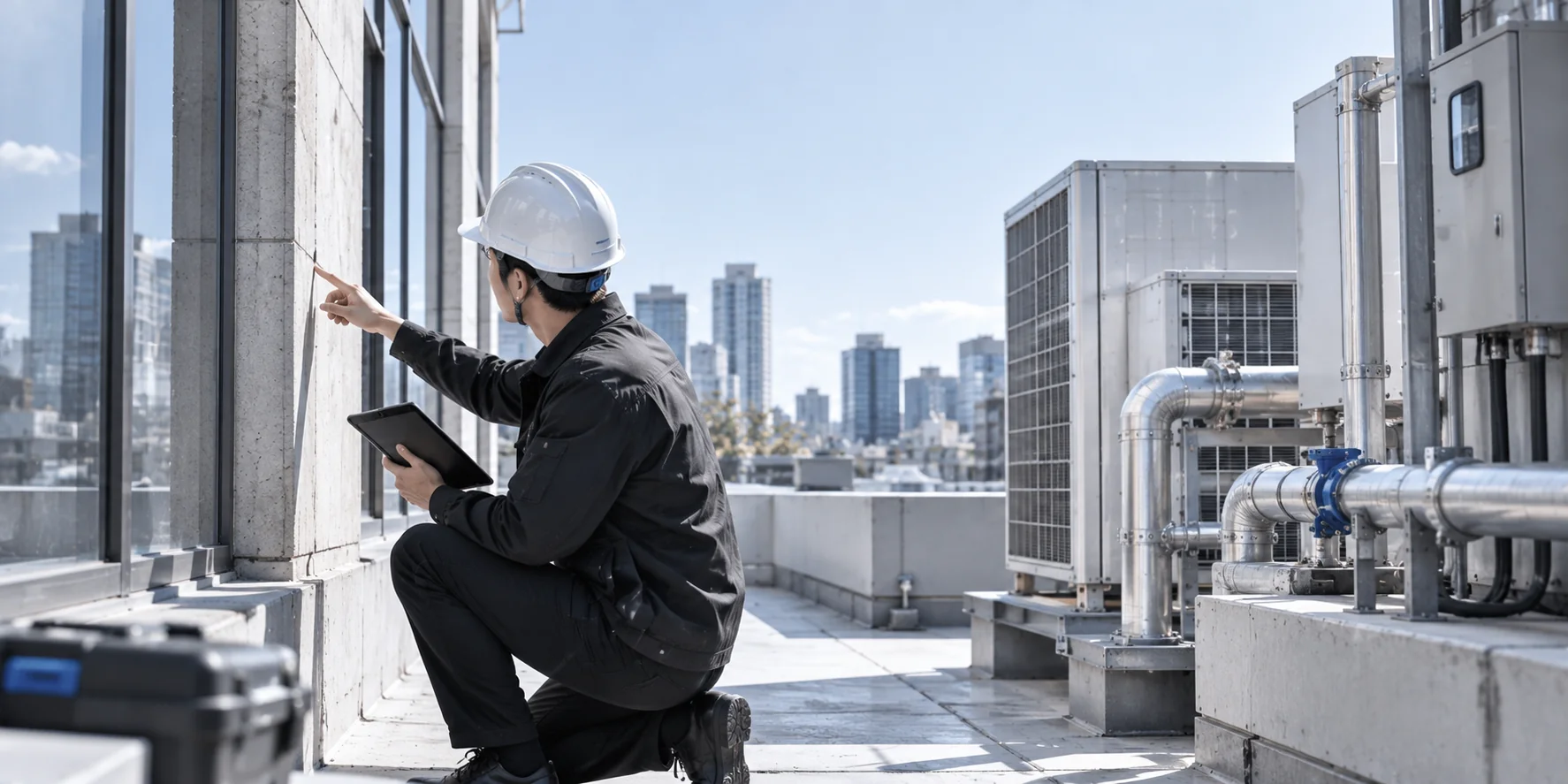
What are we managing?
Watch drainage, ponding and membrane condition in normal use, then check for leak traces or recurring cracks after rain.
Check cracks, loose or damaged finishes, discoloration and moisture traces.
Escalate to professional inspection when there is safety risk or repeated change.
Watch for pressure changes, slow drainage, odors, leakage and repeated blockage.
If the same location keeps recurring, investigate the cause rather than treating it as an isolated event.
Check repeated breaker trips, overheating, recurring outages, lighting faults and changes in common-area electricity use.
Do not attempt ad-hoc repair of safety-related symptoms.
Manage statutory inspection requirements separately from day-to-day checks of alarms, fire equipment and escape routes.
Keep mandatory inspection records distinct from general facility checks.
Connect unusual noise, door operation, stopping accuracy, repeat failures and scheduled maintenance history.
Review failure count together with accumulated cost.
Watch performance decline, noise, leakage, filters and consumables, repeated failure and replacement timing.
Review condition before peak seasonal use.
Check damage, lighting, slip hazards, drainage, access and safety.
Record locations where inconvenience or accident risk repeatedly occurs.
Find small warning signs before they become major failures.
Facility management does not mean the owner has to become a technician.
The key is knowing the normal condition, noticing small changes and handing the issue to a qualified professional at the right time.
If the same leak or failure keeps returning, simply recording that it was repaired is not enough.
Location, cause, work performed, cost and recurrence should be viewed as one history.
Different building systems have different inspection points and warning signs.
Set facility-specific criteria and checkpoints, then escalate based on repetition, expansion and safety impact.
Review it in this order.
Start with the full flow, then move through the reasons and checks in each step.
Know the normal condition first
You can only recognize change when normal condition is defined as the baseline.
Keep reference photos and notes on the normal appearance and operation of major building systems.
Do not take photos only after something fails.
Record small warning signs
Small changes such as cracks, leaks, unusual noise or reduced performance can be the beginning of a repeated failure.
Record the location, symptom, first observed date and photos, then check whether it returns.
Avoid vague notes such as 'seems strange.
'
Separate urgency from inconvenience
A safety risk and a routine inconvenience require different response speeds.
Prioritize based on safety, spread of water or damage, operational impact and whether the issue involves a regulated system.
Do not lower the urgency simply because the repair may be expensive.
Define when professional inspection is required
The owner's role is usually not to repair the system personally, but to bring in the right specialist at the right time.
Repeated failure, safety risk, regulated equipment and unexplained symptoms should be escalated to qualified contractors or inspectors.
Do not use informal repairs as a substitute for required inspection or safety work.
Keep the repair and its cost in one history
When repair details and cost records are separated, cumulative spending on the same problem is hard to see.
Keep the contractor, work performed, parts replaced, cost, completion date and photos together as one event.
Do not store the receipt separately with no link to the repair event.
Check whether the problem returns
Whether a problem comes back matters more than simply marking a repair as complete.
Set a follow-up date.
If the same location or symptom returns, compare it with the previous repair.
Do not close the case and never look at it again.
Set a clear inspection standard for each facility area.
Do not repeat definitions.
Start with what to inspect and where, then use the explanation and cases to understand why those standards matter.
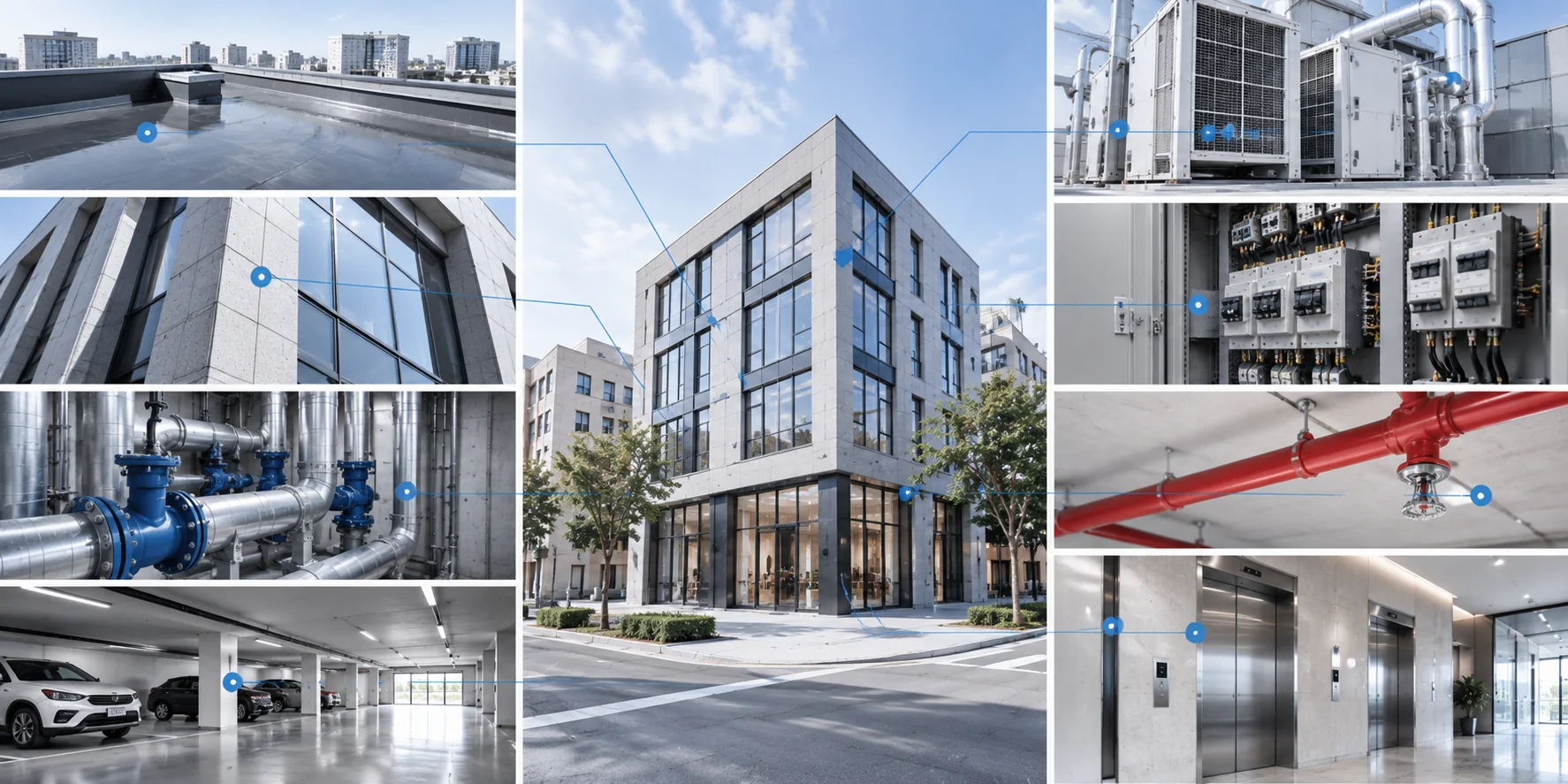
Roof and waterproofing
- Water does not remain ponded for an extended period after rain
- The waterproofing layer is not lifting or cracking
- Leaks are not recurring at the same location
- Water ingress is not extending into interior spaces
For roofs and waterproofing, recurring change matters more than simply asking whether it leaks.
Water ingress can begin as small changes on the roof well before it becomes visible indoors.
Ponding, lifted waterproofing and cracks at junctions may look minor at first, but repetition at the same location matters.
A single stain is less informative than whether the same trace returns after rain, whether the ponding area grows, or whether new change appears around an old repair.
The owner's job is not to diagnose the exact cause.
The key is to judge repetition, expansion and interior impact, then decide whether the issue is still in observation or should move to professional inspection.
After heavy rain, water collects in one part of the roof but drains within a day and there is no interior leakage.
Do not immediately assume major remedial work is required.Keep checking whether the same location repeats and whether the waterproofing changes.
Ponding keeps returning at the same location and staining appears on the ceiling below.
Move beyond simple observation and arrange professional investigation of the cause.Repeated leakage in the same location · expanding membrane damage · water ingress reaching interiors · cause cannot be identified visually
Facade
- Cracks are not widening or lengthening
- There are no signs of loose or falling finish materials
- There are no moisture traces around windows or joints
- There is no falling-object risk above pedestrian areas
For facades, change and location matter more than the mere presence of a crack.
Not every crack carries the same risk.
Compare whether an old hairline crack stays stable, whether its width or length changes, and whether it spreads in a new direction.
Loose tile or stone and opening joints can lead not only to water ingress but also to falling-object risk.
Changes above entrances and pedestrian routes should be assessed first as a safety issue, not a cosmetic one.
Many facade areas cannot be checked closely from the ground.
If the change is increasing or a falling risk is suspected, stop at visual observation and move to professional inspection.
A fine existing crack has shown no change compared with reference photos over several months.
Do not assume it is actively worsening; continue comparing location and size over time.A facade finish is opening up and small fragments are visible below.
Prioritize falling-object risk, reduce exposure to the area and arrange professional inspection.Cracks are expanding · finish materials are lifting or falling · falling-object risk · high-level access is required
Water supply and drainage
- Water pressure has not changed suddenly
- Drainage is not becoming slow or backing up
- There are no leak traces around pipes or valves
- Odor or dampness is not recurring at the same location
Water and drainage problems should be caught before a small symptom spreads across multiple areas.
Slow drainage or lower pressure can look minor but may be an early sign of blockage, leakage or pump trouble.
It matters whether the symptom appears in one area or in several places at the same time.
Distinguishing a single-unit issue from a multi-unit or multi-floor issue helps separate local plumbing problems from a shared building-system problem.
When leakage increases or there is a risk of backup or contamination, it is no longer only an observation issue.
Prioritize reducing the affected area and arranging professional inspection.
Only one basin drains slowly while the rest of the building is normal.
Start by checking the local drain and trap area.Drainage slows on several floors at the same time and some spaces begin to back up.
Treat it as a possible shared drainage-system problem and escalate to professional inspection.Repeated backup · simultaneous issues in several spaces · spreading leakage · contamination or flooding risk
Electrical systems
- Breakers are not repeatedly tripping
- There is no heat or discoloration around outlets or distribution boards
- There is no burning smell, sparking or unusual sound
- The same issue is not repeating under a particular time or load condition
With electrical systems, repeated risk signals matter more than whether equipment simply turns on.
A breaker operating once matters less than repeated trips on the same circuit.
Recording when it happens and what was running can help identify a repeating condition.
Heat, discoloration, burning odor and sparks are not simple inconvenience; they can indicate fire risk.
Do not keep resetting a breaker or reusing equipment without understanding the cause.
Electrical systems are not an area for an owner to dismantle and investigate.
When a risk signal appears, stop use where appropriate, secure the area and hand the issue to a qualified professional.
A breaker trips once immediately after several high-load appliances are used together, then operates normally.
Review the load and equipment in use and watch whether it repeats under the same conditions.The same circuit trips repeatedly and there is heat or discoloration around an outlet.
Stop repeated use and prioritize professional electrical inspection.Repeated trips · heat or burning smell · sparking · electrical-room abnormality · cause cannot be identified safely
Fire safety
- Fire equipment is not blocked or damaged
- Escape routes remain clear
- There are no persistent alarm or panel indications
- Inspection findings have not been left unresolved
For fire safety, the question is not only whether equipment is broken, but whether it will be usable when needed.
Having equipment installed is not enough.
If extinguishers are blocked or escape routes are obstructed, the system may not work as intended during an emergency.
Persistent panel indications, repeated alarms or fire doors that do not close properly may cause little everyday inconvenience but can matter significantly in an emergency.
Required inspections and specialist maintenance may be regulated and require qualified providers.
The owner should focus on observable conditions such as access, damage, abnormal indications and clear routes, and escalate issues appropriately.
Extinguishers are accessible, exit signs are visible and escape routes are clear.
Maintain that ready-to-use condition as part of routine management.The alarm/control panel continues to show a fault and a fire door does not close correctly.
Treat the condition as requiring specialist inspection and corrective action.Persistent alarm fault · impaired fire-door function · blocked escape route · required inspection findings remain unresolved
Elevators
- Floor-level stopping remains accurate
- Doors do not open or close slowly or with impact
- Vibration or unusual noise is not repeating
- Stops or faults do not occur during operation
With elevators, a small inconvenience can become a meaningful operating signal when it repeats.
A door closing slowly once matters less than whether the same symptom repeats or appears only at a particular floor.
Distinguishing the condition helps the maintenance provider investigate accurately.
Stopping error, heavy impact and repeated unusual noise can affect user safety.
Professional maintenance should take priority over informal adjustment.
The owner's role is not to repair the elevator, but to identify repetition and the circumstances in which it occurs, communicate them clearly to the maintenance provider, and prioritize safe operation.
Door closing is intermittently slow only at one floor.
Check whether the difference is floor-specific and repeatable, then give the maintenance provider a precise description.The car repeatedly stops out of level and there is heavy impact or unusual noise during travel.
Treat this as requiring prompt inspection by the elevator maintenance provider.Stops during operation · repeated leveling error · heavy impact or unusual noise · abnormal door-safety behavior
Heating and cooling
- The gap between set temperature and actual comfort is not widening
- Temperature differences between zones are not increasing
- There is no leakage, condensation or unusual noise
- Performance does not fall despite longer operating time
Heating and cooling systems often decline gradually before they fail outright.
A system turning on and off does not by itself prove normal performance.
Watch whether it needs to run longer than before to reach the same condition or whether temperature differences between zones are growing.
Leakage, condensation and drainage problems can extend beyond comfort and damage ceilings or finishes.
Check surrounding conditions together with performance change.
Once the issue goes beyond routine items such as filters or accessible housekeeping and suggests refrigerant, electrical or mechanical faults, move from owner observation to professional inspection.
Only one zone struggles to reach temperature while the other zones are normal.
Start by separating local factors such as the indoor unit and airflow in that zone.Performance falls across several zones and unusual noise from the outdoor equipment is increasing.
Move to a professional review of the overall system condition.Sharp performance decline · spreading leakage or condensation · mechanical abnormal noise · repeated faults
Parking and common areas
- There is no floor damage or slip hazard
- Lighting does not create unsafe dark zones
- Drainage is working and ponding is not recurring
- Pedestrian and vehicle routes are not obstructed
Manage common areas before small inconveniences turn into accidents and recurring complaints.
A floor crack or failed light may seem minor, but risk accumulates in spaces people use repeatedly.
Give higher priority to locations with heavy traffic.
Ponding, slippery surfaces, loose rails and blocked routes should be judged first by safety, not appearance.
Where accident risk exists, temporary risk-reduction measures may come before permanent repair.
Because common areas are shared by multiple tenants and visitors, distinguish a problem affecting one user from one that affects the overall route or safety of the building.
One parking-area light is out, but surrounding illumination remains adequate for safe movement.
Confirm the risk level and manage it as a prompt maintenance item.Water repeatedly ponds on a ramp and creates a slip hazard, or a guardrail is loose.
Reduce the immediate risk first, then carry out the required repair.Fall or slip risk · blocked movement · repeated flooding · loose structural or safety elements
This is how to review it in operation.
For each case, connect what to check, how to judge it, and what should be recorded.
The roof leak has been repaired three times.
If the same location keeps leaking, review whether each job only patched the symptom instead of addressing the cause.
Compare cumulative repair spending with the need for a more fundamental repair.
Photos / work performed / contractor / cost / recurrence
Elevator failures have become more frequent recently.
Each individual repair may be closed, but repeated shutdowns and complaints can become a larger problem than repair cost alone.
Review safety, business impact and accumulated repair cost together.
Failure date / downtime / contractor / action / recurrence
An electrical breaker keeps tripping.
Repeated tripping can be a sign that the cause needs inspection, such as overload or equipment fault, rather than repeated reset.
Escalate safety-related electrical symptoms to a qualified professional immediately.
Event date / equipment / professional inspection / outcome
Heating and cooling performance is falling and complaints are increasing.
A facility problem can move beyond comfort and affect tenant satisfaction and renewal.
If the same failure repeats, look first at safety, downtime and the scale of performance loss, then decide when specialist inspection or replacement review is appropriate.
Complaint / repair / cost / performance / decision
This is an educational building-management guide. For actual lease, tax, legal, regulatory, or facility-safety decisions, confirm the applicable local requirements and consult qualified professionals when needed.
Build a usable operating history
→