Risky transactions do not always look risky at the beginning. Small exceptions may appear between friendly explanations and otherwise normal documents, and as signing approaches the other side may begin delaying verification or changing how money is supposed to move.
WHY RED FLAGS MATTER · Why warning signs matter
Unexplained exceptions raise risk.
A single warning sign does not prove fraud. But the picture changes when explanations differ across multiple areas, access to records is restricted, and the payment method also begins to change. The six patterns below show how warning signs can connect during a real transaction.
01FIRST IMPRESSION · First impression
Risk can look normal at first.
If everything looked suspicious from the start, the decision would be easier.
If owner verification is postponed, current records are promised only after signing, and payment is requested before verification, do not view these as isolated events.
01Normal start
02Small exception
03Changed explanation
04Verification avoided
05Payment flow changes
02CONNECTED SIGNALS · Connected signals
Look for connected inconsistencies.
An agent signing the contract, a tight schedule, or a third-party account does not by itself establish a problem. Each can have a legitimate explanation.
But if direct owner confirmation is delayed, the agent's story changes, signing is repeatedly rushed, and payment is finally redirected to another person's account.
01Owner confirmation delayed
02Agent explanation changes
03Signing is rushed
04Third-party account requested
03DECISION PRESSURE · Decision pressure
Good terms can weaken checks.
A price below market or a fast transaction is not automatically a warning sign.
The more attractive the deal looks, the more important it is to preserve the verification sequence.
01Attractive price
02Decide today
03Another buyer waiting
04Pressure to skip checks
04CROSS CHECK · Cross-check
Documents must agree with each other.
A transaction is not safe simply because documents exist.
If person, authority, documents, explanation, money, and contract terms repeatedly fail to connect, do not stop at 'there is documentation.' Find out why the pieces do not match.
01PERSON
02AUTHORITY
03DOCUMENT
04STORY
05MONEY
06CONTRACT
05BEFORE PAYMENT · Before payment
Recheck last-minute changes.
If the payment structure described throughout the transaction changes immediately before transfer, do not treat it as a minor update.
If the account changes just before signing or closing, an extra amount is requested outside the contract, or you are asked to pay before verification.
01Account changes
02Recipient changes
03Amount changes
04Payment method changes
05Payment requested first
06WHEN TO STOP · When to slow down
Slow down when checks break down.
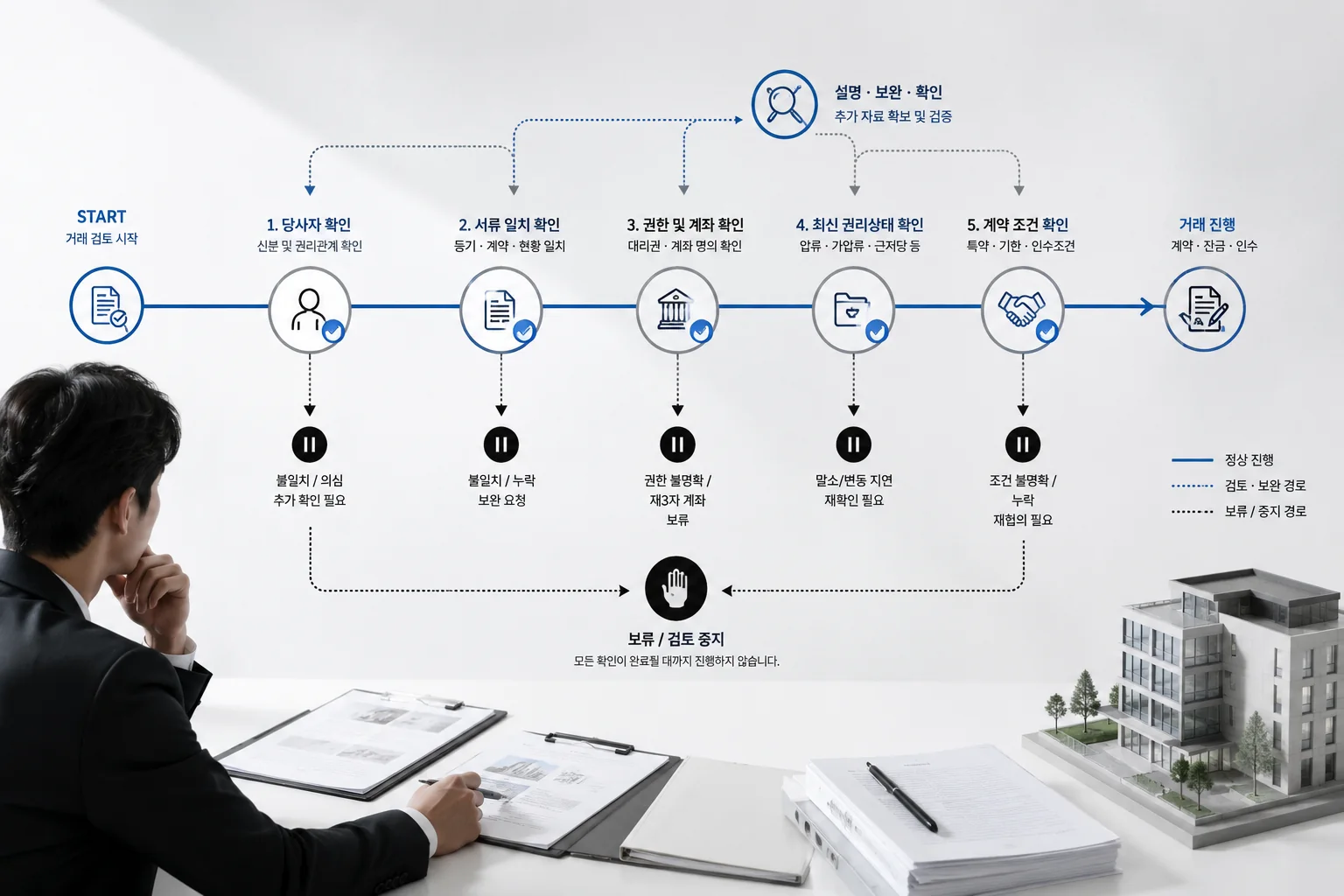
A warning sign does not mean you must immediately conclude fraud. The basic response is to raise the level of verification and slow the transaction until the necessary evidence is available.
If documents remain unavailable, explanations repeatedly change, and payment is still demanded first, completing verification matters more than meeting the proposed schedule.
01Additional verification
02Slow the process
03Hold payment
04Reconsider the transaction
RED FLAG SCAN · Warning-sign scan
Find what needs verification.
This is not a checkbox document. Read what is unusual in each SIGNAL, then use WHY and VERIFY NOW to recheck the actual transaction structure.
01
IDENTITY
Identity & Authority
SIGNAL 01
Owner and signer do not match.
WHYThe connection between the person signing and the actual rights holder has not been verified.
VERIFY NOWVerify the owner's identity and the basis for agency or representative authority, and slow the transaction until authority is confirmed.
SIGNAL 02
Agent authority proof is delayed.
WHYIt becomes difficult to confirm the actual scope of authority and the principal's intent.
VERIFY NOWVerify the scope of authority and the principal's intent directly, and hold any deposit until the authority is confirmed.
SIGNAL 03
Some co-owner authority is missing.
WHYPart of the authority required for the transaction may not be in place.
VERIFY NOWConfirm each owner's authority and any required consent before proceeding.
SIGNAL 04
Company signing authority is unclear.
WHYThe company ownership and the authority of the person signing are not connected.
VERIFY NOWCompare corporate information with representative or delegated authority and sign only after authority is confirmed.
02
DOCUMENT
Documents
SIGNAL 01
Current records are hard to verify.
WHYYour opportunity to verify the current condition directly is reduced.
VERIFY NOWReview current source records yourself and delay the decision until the reason for withholding them is resolved.
SIGNAL 02
Only partial records are shown.
WHYIt is difficult to check the issue date, full context, or omitted information.
VERIFY NOWCompare again using records that show the full content and relevant date.
SIGNAL 03
Key facts differ across documents.
WHYThe documents are not pointing to the same set of facts.
VERIFY NOWList each inconsistency and determine which information reflects the current situation.
SIGNAL 04
Key records come after signing.
WHYInformation needed to make the decision is being pushed until after commitment.
VERIFY NOWObtain the information needed for the decision first and hold signing or payment until it is reviewed.
03
MONEY
Money Flow
SIGNAL 01
Payment redirected to a third party.
WHYThe link between the contracting party and the authority to receive funds may be broken.
VERIFY NOWVerify the account holder and the basis for receiving funds, and do not transfer until the relationship is explained.
SIGNAL 02
The payment account changes late.
WHYThe payment structure you previously verified has changed immediately before funds move.
VERIFY NOWReconfirm the reason for the change and authority over the new account, then compare it with the contract.
SIGNAL 03
Off-contract payment requested.
WHYA flow of money not documented in the agreement has been added.
VERIFY NOWReconcile the total payment and its basis in writing before deciding whether to transfer.
SIGNAL 04
Payment method is unclear.
WHYIt may become difficult to verify the payment basis and actual recipient later.
VERIFY NOWClarify the reason for payment and the recipient, and use a verifiable payment method.
04
PRESSURE
Pressure
SIGNAL 01
You are pressured to sign today.
WHYThe pressure can reduce verification time and change the proper order of decision-making.
VERIFY NOWSecure enough time to verify and do not finalize the signing schedule before reviewing the required information.
SIGNAL 02
Deposit requested before checks.
WHYMoney begins moving before verification is complete.
VERIFY NOWRestore the proper sequence and decide on payment only after reviewing the core records.
SIGNAL 03
Independent review is discouraged.
WHYAn independent verification path may be blocked.
VERIFY NOWReview important items independently and ask why outside verification is being discouraged.
SIGNAL 04
Questions dismissed; speed demanded.
WHYImportant inconsistencies may be pushed past without an answer.
VERIFY NOWSlow the process until important questions are answered and keep a record of the responses.
05
STORY
Explanation Consistency
SIGNAL 01
Tenancy figures keep changing.
WHYThe actual assumed amount and closing calculation may be different from what you expected.
VERIFY NOWRecalculate from tenant-level source records and do not finalize the amount until the differences are explained.
SIGNAL 02
Rights story conflicts with records.
WHYThe transaction described verbally may not match the current rights status.
VERIFY NOWRebuild the facts from current rights records and resolve the difference between the records and the explanation.
SIGNAL 03
The transaction story keeps changing.
WHYYou need to determine whether a material fact affecting the contract is changing as well.
VERIFY NOWCheck the changed facts against evidence and assess whether they affect the contract terms.
SIGNAL 04
Important promises vary by speaker.
WHYIt can become unclear who is responsible for the promise and what was actually agreed.
VERIFY NOWConsolidate the verbal explanation into one version and align it with the contract and supporting records.
06
AVOIDANCE
Verification Avoidance
SIGNAL 01
Responsible contact keeps changing.
WHYThere may be no accountable person giving a clear answer.
VERIFY NOWAsk the same question to the responsible contracting party and record the basis for the answer.
SIGNAL 02
Verification itself is discouraged.
WHYThe normal verification process itself may be blocked.
VERIFY NOWMaintain the necessary verification process and hold the transaction if required information is not provided.
SIGNAL 03
Direct confirmation is avoided.
WHYIt becomes difficult to verify key facts independently.
VERIFY NOWSet the required verification method and timing, and reconsider the transaction if it cannot be completed.
SIGNAL 04
Dismissed as 'standard practice'.
WHYThe actual basis for applying that practice to this transaction has not been verified.
VERIFY NOWVerify the authority, documents, and payment basis for this specific transaction instead of relying on a general claim of custom.
STOP SIGNAL · When to stop and verify
Pause when core facts diverge.
01
One signal
Verify the source records and authority behind that item.
02
Repeated or multiple signals
Slow the signing or payment schedule and cross-check different sources.
03
Authority + records + money conflict
Hold signing and payment until the core inconsistencies are resolved, and reconsider the transaction itself.
The number of signals is not a fraud probability score. The purpose is to raise the level of verification and the strength of your response when inconsistencies appear.
This guide provides general educational information. Legal, tax, registration and transaction decisions can vary by jurisdiction and deal structure.