Sell or Hold
Is it time to keep holding, or to consider selling?
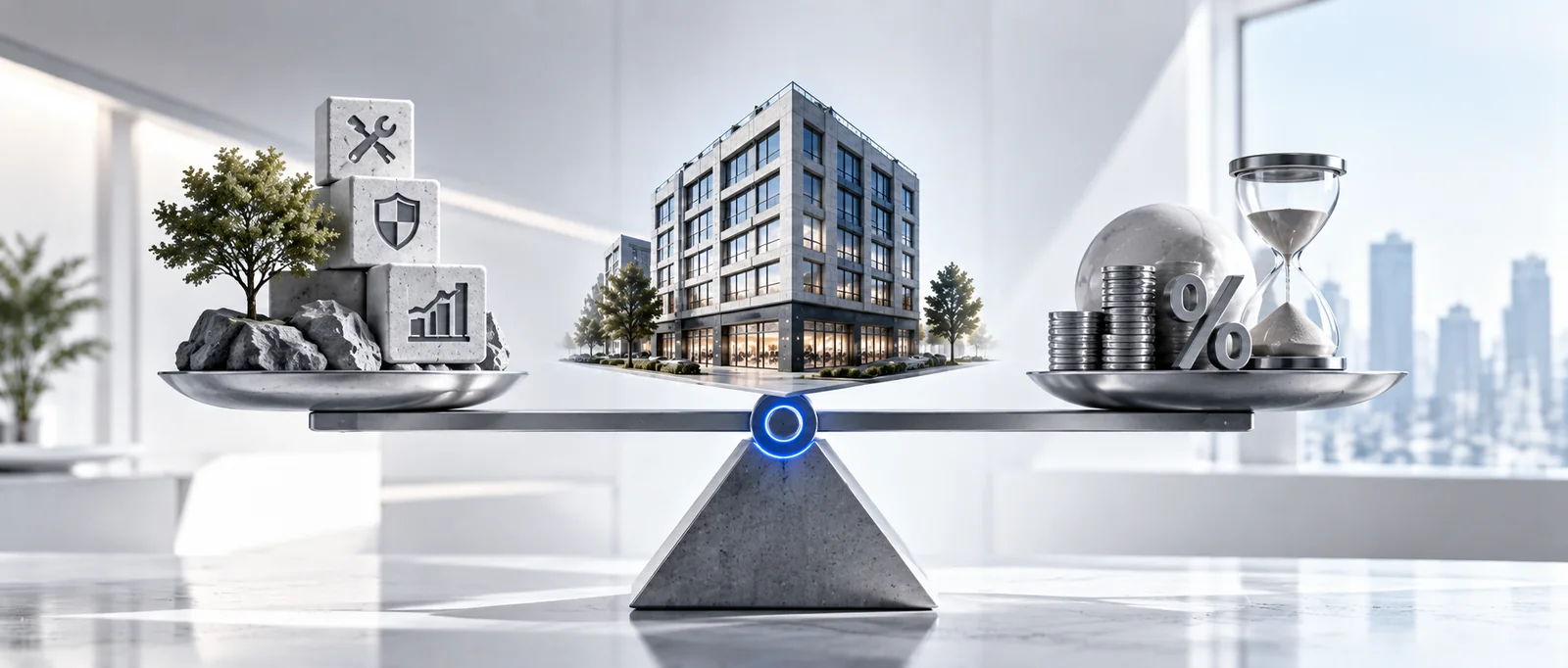
Before looking at price, clarify why you are considering a sale.
There is rarely only one reason to consider selling a property. The asset itself may have changed through higher prices, more vacancy, or changes in tenants.
Financing conditions may also change through heavier debt service or major capital needs. The owner's priorities can change as management becomes more demanding or capital is needed elsewhere.
If you decide based on one change alone, it is easy to miss the rest. Separate changes in the asset, financing, and the owner's objectives.
The decision is not about the building alone. Start by seeing how these three changes overlap today.
Has the asset changed?
Review changes in the property itself, including rental income, vacancy, tenants, capital needs, and the surrounding market.
Have financing conditions changed?
Review conditions that change actual cash flow, such as loan rates, maturity, principal repayment, and refinancing options.
Have the owner's objectives changed?
Review changes in current ownership goals, such as liquidity needs, management time, other investments, and portfolio structure.
Review six factors before comparing hold versus sell
Look beyond today’s price to current income, future income, major costs, financing, tied-up capital, and your ownership objective.
Bring the property's actual net cash flow from the analysis stage into the sell-or-hold decision.
Do not re-teach yield or cost calculations here; focus on whether that cash flow still justifies holding the property.
The first question is simple: “How much does this property actually leave you today?
”
Stable rental income today does not guarantee the same result going forward.
Major tenant expirations, rent resets, recurring vacancy, tenant turnover, new supply, changes in the local market, and dependence on a single tenant can all change future cash flow.
The goal is not to predict the future exactly, but to identify what could disrupt current income over the next one to three years.
Bring major facility history and expected CAPEX identified during ownership into the hold decision.
Do not repeat maintenance instructions; focus only on how near-term capital spending changes the reason to keep holding.
This section is about the effect of expected costs on the hold decision, not how to maintain the facilities.
Check the current loan balance, maturity, fixed or floating rate, future principal burden, refinancing options, cash-flow sensitivity to rates, and prepayment terms.
If financing costs rise while rental income stays flat, the owner's actual cash return falls.
A sell-or-hold decision looks at both the building and the financing structure used to hold it.
Holding the property may provide rental income and future appreciation, but the equity invested in it cannot be used elsewhere at the same time.
Identify the real use for recovered capital after a sale—another property, business funding, debt reduction, liquidity, or diversification.
Do not try to forecast another investment's return.
Check whether the recovered capital has a real use.
Check whether the original purpose—stable rental income, long-term ownership, capital gains, owner-occupation, succession, or diversification—still applies.
Also ask whether you have exceeded the original holding period, still want to manage the property directly, and have a clear purpose for sale proceeds.
Holding should always have a reason that is valid today.
Use five steps for the actual sell-or-hold decision
Separate the reasons first, then compare the hold and sell scenarios on the same basis.
Separate the reasons you started considering a sale.
Write down what triggered the sale discussion.
Sort reasons such as management fatigue, higher interest rates, rising vacancy, price appreciation, or another investment plan into asset, financing, and owner-related factors.
This prevents one emotion or one event from driving the entire decision.
Do not conclude based on one recent vacancy or temporary stress.
Do not treat “the price went up” and “we should sell” as the same statement.
You can separate the reasons for considering a sale into asset, financing, and owner factors, and explain whether each is temporary or persistent.
Build a one-to-three-year hold scenario.
Do not assume today's conditions remain unchanged.
Review expected rent, vacancy, tenant changes, financing costs, facility costs, major repairs, and management burden together.
The objective is not to forecast perfectly, but to identify the variables that could occur.
Do not simply extend current income for three years.
Use both a base case and a conservative case instead of one optimistic forecast.
You have organized the rent, vacancy, financing, and facility variables that may change over the next one to three years into base and conservative scenarios.
List what changes if you sell now.
Before calculating an exact sale price, look at what the sale itself changes: recovering invested capital, reducing or repaying debt, ending management work and future capital spending, creating liquidity, or opening room for another investment or business.
A sale is not simply removing an asset; it is reallocating the capital and responsibilities tied to it.
Do not equate the expected sale price with the cash that will remain.
Separate taxes, prepayment costs, and transaction costs as items requiring further confirmation.
You have separated the burdens that disappear from the capital that is recovered, and marked unconfirmed costs for further verification.
Compare holding and selling on the same basis.
You cannot compare fairly if you look only at income when holding and only at sale price when selling.
For holding, compare future cash flow, expected costs, potential value changes, management burden, and financing risk.
For selling, compare recoverable capital, transaction costs, debt cleanup, relief from management, and how the capital can be used afterward.
Compare using the same time horizon and objective.
If the outcomes are similar, do not force a conclusion; move the unresolved items to further verification.
You can place holding and selling side by side using the same period, objective, and comparison criteria and explain the difference.
Separate the variables you still do not know.
A sell-or-hold decision always includes figures you cannot know immediately, such as the realistic sale price, exact taxes, prepayment costs, legal issues, and expected major repairs.
Do not force estimates into a conclusion.
Separate them as items to confirm.
Refusing to treat an unknown number as certain is part of good decision-making.
Separate items requiring professional confirmation from items you can verify from internal records.
“Unknown” is itself useful decision information.
You have separated confirmed values from items requiring further verification and assigned a person or source for each unresolved item.
Similar conditions today can lead to different decisions when the future changes
These cases are not answers. They show which conditions should be considered together.
CASE A · Current conditions are stable
Rental income is stable and the property has long-term tenants.
Debt burden is modest, no major facility replacement is expected soon, management burden is low, and there is no large separate need for capital.
In this case, a substantial increase in market value alone may not be enough reason to rush a sale.
First assess the stability the asset provides and the expected result of continuing to hold it.
CASE B · Future conditions are changing
Current rental income is holding up, but a key tenant expires in one year, a major facility replacement is expected within two years, the loan carries a floating rate, and management burden is increasing.
There is also a clear plan for capital after a sale.
The property may look stable today, but when future vacancy, capital spending, financing costs, and alternative uses of capital are considered together, the case for revisiting a sale can become stronger.
The difference between the two cases is not today's price, but the conditions ahead.
CASE C · The same property can lead to a different decision when you look at the numbers
Educational example: annual net cash flow is KRW 48 million, equity is KRW 1.
0 billion, and the outstanding loan is KRW 800 million at a floating rate.
A key tenant expires in 18 months, and expected facility costs within two years are KRW 120 million.
Assume there has been no recent vacancy and there is a clear investment or business plan for the capital recovered after a sale.
Looking only at today's figures, annual cash flow of KRW 48 million may appear stable.
But tenant expiry, capital spending, and floating-rate financing can change future holding performance.
If the realistic sale price, taxes, and transaction costs are still unknown, you cannot yet conclude that selling is better.
The purpose of this case is to show how to look at current income together with future conditions.
Answer these six questions before making a sell-or-hold decision
An unanswered question is something to verify, not something to force into a conclusion.
You need actual ownership performance—not gross rent—to compare holding with selling.
If you do not have a baseline, align actual receipts and expenses for the latest 12 months and recalculate net cash flow.
Even if current income holds, large CAPEX can change future holding performance.
Gather inspection records, repair history, and estimates to confirm the timing and expected amount of major repairs.
This is a key check for future sustainable income, not just today's income.
Compare lease agreements with recent vacancy and marketing records to reassess vacancy risk after expiry.
Even when the asset is unchanged, financing changes can alter holding cash flow.
Use the loan agreement and confirmation from the financial institution to update maturity, interest, repayment, and refinancing terms.
The value of a sale may depend less on converting the asset to cash than on the next use of that capital.
Write down the priority use and required timing for the recovered capital to see whether the sale objective is tied to a real capital plan.
This final question tests whether holding is inertia or an intentional choice.
Write the holding purpose in one sentence and revisit any mismatch with current income, risk, or capital plans.
Do not decide from a single reason
Whether you sell or hold, relying on one number or one emotion can hide other important conditions.
Price appreciation alone does not determine the best time to sell.
Consider future performance if held and the use of capital after a sale.
Current rent alone cannot explain future vacancy, facility costs, or financing costs.
Tax is important, but it is only one variable in the overall capital decision.
Management burden is a real factor, but it must be considered alongside price, costs, and the post-sale capital plan.
Market forecasts are reference material, not the sole basis for a hold decision.
Three things to confirm before the decision is complete
This content is an educational guide for commercial-property hold and sale decisions. Actual sale price, taxes, debt repayment, rights, and building safety depend on the transaction and local rules and may require professional review.