Sale Preparation
Before selling, is this property ready to be explained?
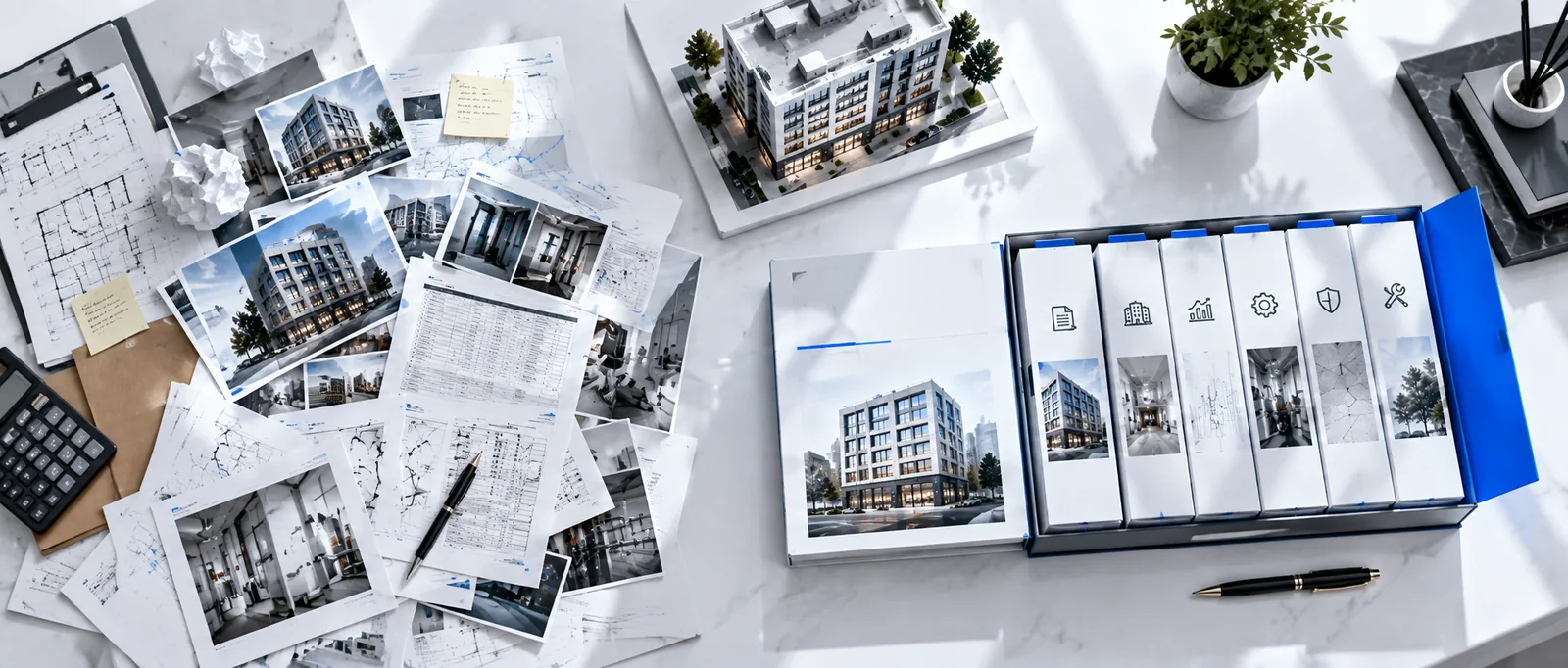
Before selling, is this property ready to be explained?
Sale Preparation is not about managing the property again. It is about turning records built during ownership into a sale information pack that a buyer can understand at a glance.
During ownership, records need to be updated continuously. EXIT does not repeat those management methods.
Combine the lease summary as of one reference date, the latest 12 months of income and expenses, facility history, and items requiring further verification into one explanation structure.
Do not interpret contracts or administrative documents legally here. Confirm only whether they are current and whether summaries match their supporting records.
Mark differences requiring judgment as items to verify. Leave legal interpretation to the contract-check stage or a qualified professional.
Completion is not measured by the volume of documents. A reader should be able to follow the current condition in the order: summary → evidence → further verification.
What to confirm first in this step
Do not stop at what to look at. Connect each item to the evidence you will check and the next decision it supports.
Without re-analyzing lease records maintained during ownership, move the reference date, tenant, deposit, rent, lease expiry, and vacancy into a single sale summary.
Link contracts as evidence and flag any mismatch so the current version can be confirmed.
This page does not cover how to reduce vacancy or market space.
Extract only the occurrence date, current status, confirmed cause, and ongoing action from existing records so the buyer can understand what remains unresolved today.
Do not repeat inspection cycles or maintenance methods.
Put only recent inspections, repair history, recurring failures, expected one-to-three-year CAPEX, and supporting evidence into the sale facility summary.
Do not judge technical adequacy here; only mark whether further verification is required.
Instead of explaining the legal effect of clauses or permits, mark only whether records exist, whether they are current, whether they match the summary, and whether further verification is needed.
Send interpretation questions to contract review or the relevant authority.
Do not re-analyze yield or appropriate expenses.
Align income and expense figures to the same period, such as the latest 12 months, connect them to evidence, distinguish one-off, recurring, and estimated values, and prepare them for the pricing stage.
Organize the pack as a one-page summary, lease evidence, income and expense evidence, facility materials, and a further-verification list.
Mark the status and location of each item so the same documents do not have to be searched for repeatedly when a buyer asks questions.
Work through five practical steps
Each step should define the task, what to check, what to watch out for, and what completion looks like.
Extract only sale-relevant materials from operating records.
Do not create a new management record.
Select only the existing records needed to explain the property's current condition.
Do not hand over the entire management archive as-is.
Extract only what is needed to explain the sale.
The list of materials included in the sale summary is fixed.
Align the reference date across all summaries.
Align the reference dates for leases, vacancy, deposits, income and expenses, and facility condition so the current property can be explained at one point in time.
Do not combine figures from different dates as though they describe the same point in time.
Each summary shows its reference date and can be compared consistently with the others.
Check the link between summaries and supporting evidence.
Connect summary values to evidence such as contracts, payment records, and inspection materials, and flag differences for further verification.
Do not edit discrepancies just to make the numbers match.
Every key figure has either supporting evidence or a further-verification status.
Turn problem items into “explanation + verification path.”
For vacancy, arrears, missing documents, and unfinished repairs, record the current status and next verification path rather than hiding the issue.
Do not present unresolved items as normal.
Each problem item shows both its current status and the next verification step.
Fix the order of the PACK.
Bundle shared materials in the order: summary → supporting evidence → further-verification list.
Do not share personal information or unnecessary internal records in bulk.
A first-time reader can follow the current condition in the same sequence.
Use situations to follow the decision flow
The cases do not give a single right answer. They show what facts to observe and what to verify next.
A property with organized records
Seven tenants, the latest 12 months of income and expenses, two years of repair history, and major facility inspection records are all organized to one reference date.
Deposits and rents in the lease summary match the contracts, and the start date and current marketing terms are recorded for one vacant unit.
This does not mean there are no issues.
It means that when a question arises, you can immediately identify the material used to verify it.
In this state, the organized materials can move forward as evidence for the pricing stage.
A property with mixed document versions
Information exists across contracts, spreadsheets, messages, and handwritten records, but it is unclear which lease summary is the latest.
Stated rent differs from actual receipts, and supporting evidence is missing for two recent repairs.
Currency and consistency matter before document volume.
Starting price discussions now would lead to the same questions being checked repeatedly.
First identify the current version and confirm the reason for each discrepancy.
When the numbers do not match
Educational example: eight tenants; total deposits of KRW 420 million in contracts but KRW 390 million in the lease summary; two units vacant for seven months; and an expected elevator repair of KRW 60 million within two years.
The KRW 30 million deposit gap directly affects final settlement, while long-term vacancy and CAPEX affect both pricing and due-diligence questions.
The point is not that the price must be reduced.
It is to align the evidence behind current figures and future costs first.
Confirm the cause of the deposit gap, vacancy marketing status, and CAPEX evidence before moving to pricing strategy.
Six questions you should be able to answer in this step
Not knowing an answer is not failure. It shows where further verification is needed.
This is the starting point for distinguishing the current condition from a past condition.
If there is no reference date, build a new summary from the latest lease agreements.
Deposits are directly connected to settlement at the end of the transaction.
If not, create a tenant-by-tenant difference table and confirm the latest evidence.
This helps a buyer understand re-leasing potential better than one vacancy-rate figure.
If the cause is unknown, first review the previous lease terms and recent marketing activity.
Future CAPEX is a common question in both pricing and due diligence.
If the amount is unclear, mark inspections and estimates as items requiring further verification.
This determines whether the number can be explained and defended.
If evidence is missing, mark it as an estimate and define the verification path.
Knowing what you do not know lets you prepare professional review and requests for additional materials.
Create a separate unresolved-items list and assign an owner and confirmation source to each item.
Sale Preparation: three things to remember
Good sale preparation is not about making the property look better.
It is about connecting existing facts and records so a buyer can follow them without gaps.
This page is a general educational checklist. Actual price, tax, rights, financing, and building-condition decisions depend on transaction terms and local rules and may require confirmation from relevant institutions or professionals.
Use the organized current condition to define the price range you can explain and defend.
→