← Back to Contract04 · TERMS

Contract terms & special clauses

How do you turn findings and agreements into enforceable deal terms?

Convert identified risk into clear, executable terms.

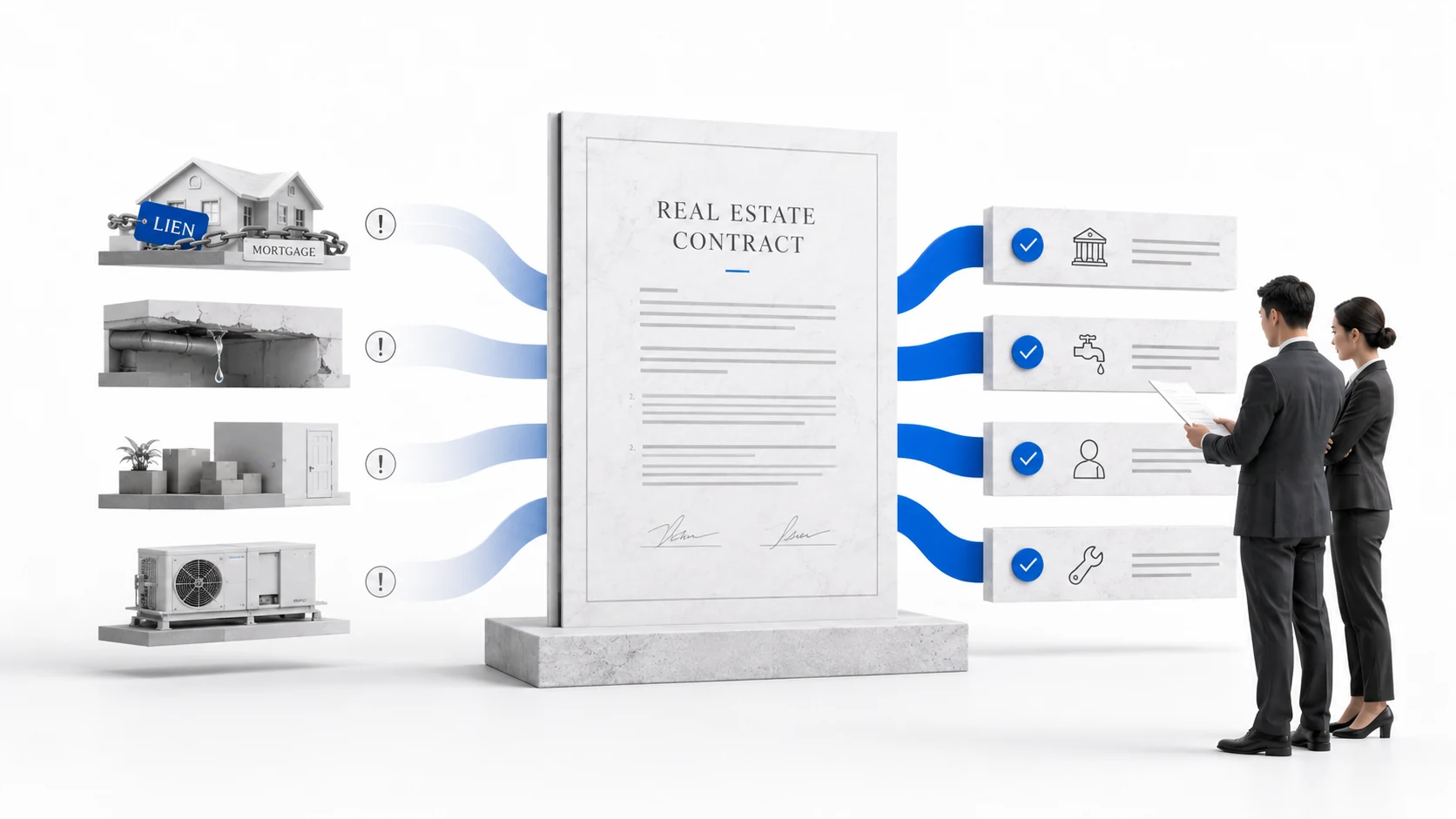
Overview graphic for Contract terms & special clauses
CONTRACT FLOW

Turn facts into contract terms.

A contract records more than price. It allocates responsibility for the property, payments, handover, rights, tenancy, repairs, facilities and document delivery.

  1. 01FACTS

    A contract records more than price. It allocates responsibility for the property, payments, handover, rights, tenancy, repairs, facilities and document delivery.

  2. 02RISK

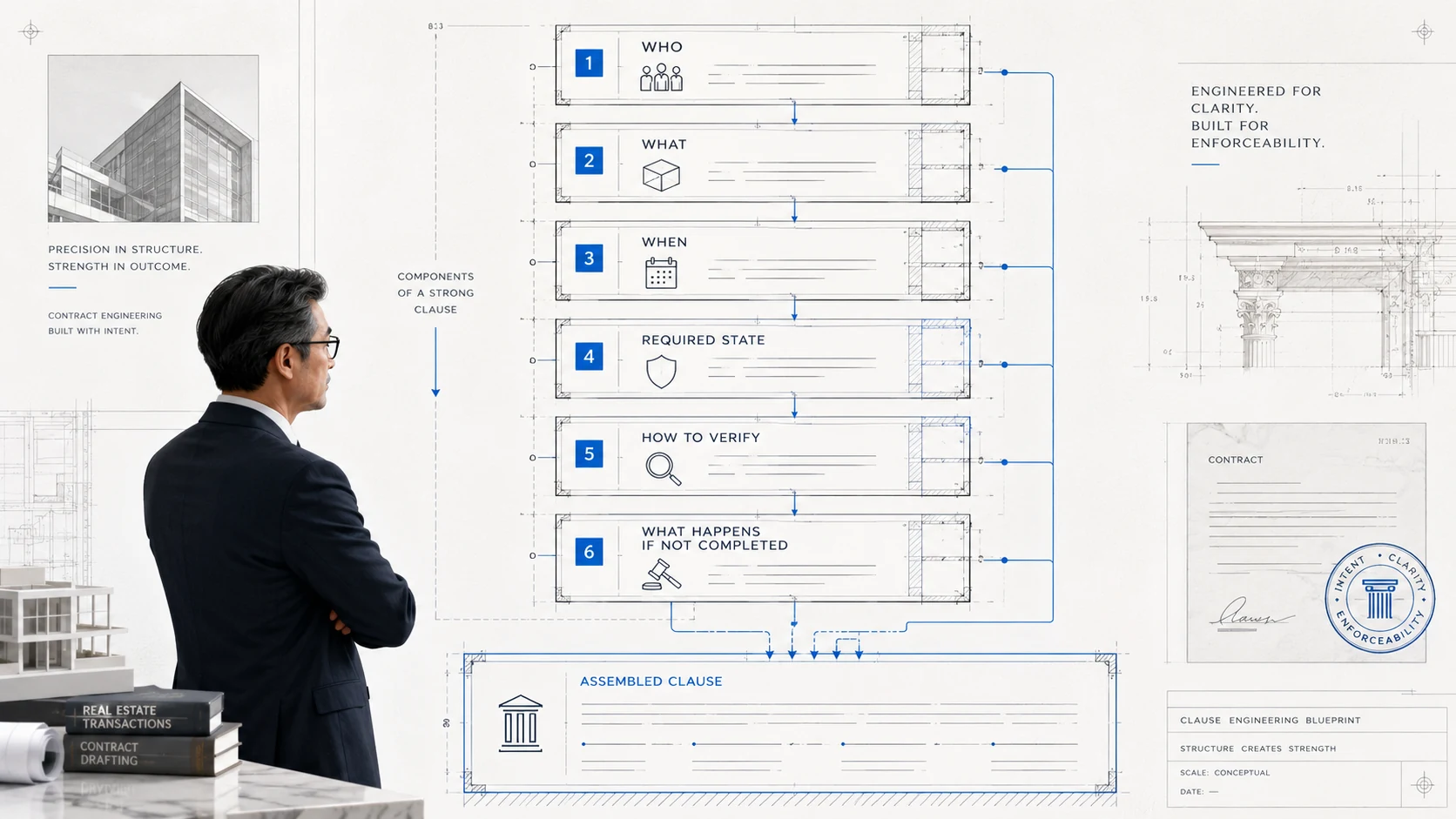
    A useful special clause identifies the responsible party, required action, deadline, completion standard, verification method and what happens if the requirement is not met.

  3. 03RESPONSIBILITY

    Vague promises can sound identical during negotiation but leave room for different interpretations later. “Resolve before closing” can mean different things unless completion is defined.

  4. 04DEADLINE

    Start with the risk or unresolved issue. Define who handles it, what must be done, by when, how completion is confirmed and how the transaction responds if it is not completed.

  5. 05VERIFY

    If a right must be cleared before closing, “the seller will handle it” is only a starting point.

  6. 06IF NOT

    Who → what → by when → completion standard → verification → if not completed. Turn risk into an executable term.

  7. 07TERM

    A contract records more than price. It allocates responsibility for the property, payments, handover, rights, tenancy, repairs, facilities and document delivery.

NORMAL BASELINE

Start with the agreed baseline.

A useful special clause identifies the responsible party, required action, deadline, completion standard, verification method and what happens if the requirement is not met.

01FACTS→
02RISK→
03RESPONSIBILITY→
04DEADLINE→
05VERIFY→
06IF NOT
When the sequence connects without unexplained gaps, move to the next verification.
Practical comparison graphic for Contract terms & special clauses
VARIABLES

Check what needs a clear term.

A useful special condition makes five things visible: the current problem, who must act, what must be done, when it must be done, and how completion will be verified. A clause does not automatically eliminate factual or legal risk, so first decide whether the underlying problem is actually controllable through contract terms.

01

Define the problem first.

Before writing a clause, describe the current state and the desired finished state in one sentence each. If the problem is vague, the clause is likely to become vague as well.

WHAT TO CHECK
  • Current state
  • Desired state
  • Contract terms affected
  • Verification timing
WHY IT MATTERS

Before drafting a special condition, clarify what remains unresolved. A lien release, repair, tenancy issue, or document delivery problem requires a different type of condition.

PREVENT

Current state

IF DISCOVERED

Can the problem be defined clearly in one sentence?

Resolve the difference before moving to payment or closing.
02

Set the responsible party and deadline.

It must be clear whether the seller, buyer, or another party must act and by what time. Otherwise it is difficult to judge actual performance.

WHAT TO CHECK
  • Responsible party
  • Required action
  • Deadline
  • Who bears related costs
WHY IT MATTERS

Instead of saying 'resolve everything before closing,' state who must do what, by when, what the finished state looks like, and how completion will be confirmed.

PREVENT

Responsible party

IF DISCOVERED

Is it clear who must do what?

Resolve the difference before moving to payment or closing.
03

Set a completion standard and evidence.

Do not stop at phrases such as 'repair completed' or 'release completed.' Decide what evidence or observation will be used to confirm completion.

WHAT TO CHECK
  • Official records where applicable
  • Physical inspection
  • Receipts or confirmation documents
  • Photos or lists as supporting evidence
WHY IT MATTERS

If there is no plan for non-performance, the parties may be forced to negotiate from scratch on closing day.

PREVENT

Official records where applicable

IF DISCOVERED

Is the deadline or required timing clear?

Resolve the difference before moving to payment or closing.
04

Review the next step if performance fails.

Consider in advance how non-performance affects closing, additional time, payment, or whether the transaction should be reconsidered.

WHAT TO CHECK
  • Connection to payment
  • Additional performance period
  • Reconsider the transaction
  • Professional review
WHY IT MATTERS

Before drafting a special condition, clarify what remains unresolved. A lien release, repair, tenancy issue, or document delivery problem requires a different type of condition.

PREVENT

Connection to payment

IF DISCOVERED

Can you identify what proves completion?

Resolve the difference before moving to payment or closing.
MISSED POINT

Easy-to-miss contract terms.

Special conditions are not about adding as much legal language as possible. They are about turning unresolved risks from the review process into conditions that can actually be performed and checked.

01

Can the problem be defined clearly in one sentence?

Before writing a clause, describe the current state and the desired finished state in one sentence each. If the problem is vague, the clause is likely to become vague as well.

02

Is it clear who must do what?

It must be clear whether the seller, buyer, or another party must act and by what time. Otherwise it is difficult to judge actual performance.

03

Is the deadline or required timing clear?

Do not stop at phrases such as 'repair completed' or 'release completed.' Decide what evidence or observation will be used to confirm completion.

04

Can you identify what proves completion?

Consider in advance how non-performance affects closing, additional time, payment, or whether the transaction should be reconsidered.

05

Have you considered the next action if the condition is not performed?

The same wording can have a different effect depending on the asset, transaction structure, existing rights, and stage of the deal.

HOW TO CHECK

Write terms that can be verified.

Special conditions are not about adding as much legal language as possible. They are about turning unresolved risks from the review process into conditions that can actually be performed and checked.

  1. 01

    Define the problem first.

    LOOK HERE

    Before writing a clause, describe the current state and the desired finished state in one sentence each. If the problem is vague, the clause is likely to become vague as well.

    COMPARE

    Current state

    NORMALThe current evidence matches the expected condition.
    IF DIFFERENTIdentify the cause and impact of the difference.
    ACTION
    • Current state
    • Desired state
    • Contract terms affected
    • Verification timing
    Can the problem be defined clearly in one sentence?
  2. 02

    Set the responsible party and deadline.

    LOOK HERE

    It must be clear whether the seller, buyer, or another party must act and by what time. Otherwise it is difficult to judge actual performance.

    COMPARE

    Responsible party

    NORMALThe current evidence matches the expected condition.
    IF DIFFERENTIdentify the cause and impact of the difference.
    ACTION
    • Responsible party
    • Required action
    • Deadline
    • Who bears related costs
    Is it clear who must do what?
  3. 03

    Set a completion standard and evidence.

    LOOK HERE

    Do not stop at phrases such as 'repair completed' or 'release completed.' Decide what evidence or observation will be used to confirm completion.

    COMPARE

    Official records where applicable

    NORMALThe current evidence matches the expected condition.
    IF DIFFERENTIdentify the cause and impact of the difference.
    ACTION
    • Official records where applicable
    • Physical inspection
    • Receipts or confirmation documents
    • Photos or lists as supporting evidence
    Is the deadline or required timing clear?
  4. 04

    Review the next step if performance fails.

    LOOK HERE

    Consider in advance how non-performance affects closing, additional time, payment, or whether the transaction should be reconsidered.

    COMPARE

    Connection to payment

    NORMALThe current evidence matches the expected condition.
    IF DIFFERENTIdentify the cause and impact of the difference.
    ACTION
    • Connection to payment
    • Additional performance period
    • Reconsider the transaction
    • Professional review
    Can you identify what proves completion?
  5. 05

    Do not copy online clauses word for word.

    LOOK HERE

    The same wording can have a different effect depending on the asset, transaction structure, existing rights, and stage of the deal.

    COMPARE

    Reflect transaction facts

    NORMALThe current evidence matches the expected condition.
    IF DIFFERENTIdentify the cause and impact of the difference.
    ACTION
    • Reflect transaction facts
    • Check conflicts with other clauses
    • Review legal effect
    • Keep wording internally consistent
    Have you considered the next action if the condition is not performed?
WHEN THINGS DO NOT MATCH

Resolve unclear terms first.

01
SAID / EXPECTEDThe parties agree that a mortgage or similar security right will be released before closing.
≠
FOUNDIf timing, verification, and the sequence with payment are missing, execution may still be unclear on closing day.
ACTION

Structure the clause around responsibility, timing, proof of release, and its relationship to payment.

02
SAID / EXPECTEDThe seller says a leak will be repaired before closing.
≠
FOUNDThe parties may have different ideas about the scope of the repair and what counts as finished.
ACTION

Specify the repair target, completion state, verification method, and cost responsibility.

03
SAID / EXPECTEDThe parties agree that a specific unit will be delivered vacant.
≠
FOUNDA planned move-out is not the same as actual vacancy and completed deposit settlement.
ACTION

Clarify the handover condition, deadline, verification method, and relationship to the closing payment.

01Can the problem be defined clearly in one sentence?
02Is it clear who must do what?
03Is the deadline or required timing clear?
04Can you identify what proves completion?
05Have you considered the next action if the condition is not performed?
06Resolve the difference before moving to payment or closing.
DEEP DIVE 01

Define the problem in one sentence first.

Before drafting a special condition, clarify what remains unresolved. A lien release, repair, tenancy issue, or document delivery problem requires a different type of condition.

01

Define the problem first.

Before writing a clause, describe the current state and the desired finished state in one sentence each. If the problem is vague, the clause is likely to become vague as well.

Current state
02

Set the responsible party and deadline.

It must be clear whether the seller, buyer, or another party must act and by what time. Otherwise it is difficult to judge actual performance.

Responsible party
03

Set a completion standard and evidence.

Do not stop at phrases such as 'repair completed' or 'release completed.' Decide what evidence or observation will be used to confirm completion.

Official records where applicable
Can the problem be defined clearly in one sentence?
DEEP DIVE 02

A good condition shows responsibility and how completion will be verified.

Instead of saying 'resolve everything before closing,' state who must do what, by when, what the finished state looks like, and how completion will be confirmed.

01

Review the next step if performance fails.

Consider in advance how non-performance affects closing, additional time, payment, or whether the transaction should be reconsidered. Clauses with important legal consequences may require professional review.

Connection to payment
02

Do not copy online clauses word for word.

The same wording can have a different effect depending on the asset, transaction structure, existing rights, and stage of the deal. Samples are useful as thinking tools, but the actual clause must match the facts of the transaction.

Reflect transaction facts
03

Define the problem first.

Before writing a clause, describe the current state and the desired finished state in one sentence each. If the problem is vague, the clause is likely to become vague as well.

Current state
Is it clear who must do what?
DEEP DIVE 03

Think about what happens if the condition is not performed.

If there is no plan for non-performance, the parties may be forced to negotiate from scratch on closing day. Important conditions should be reviewed together with the next action if they are not completed.

01

Set the responsible party and deadline.

It must be clear whether the seller, buyer, or another party must act and by what time. Otherwise it is difficult to judge actual performance.

Responsible party
02

Set a completion standard and evidence.

Do not stop at phrases such as 'repair completed' or 'release completed.' Decide what evidence or observation will be used to confirm completion.

Official records where applicable
03

Review the next step if performance fails.

Consider in advance how non-performance affects closing, additional time, payment, or whether the transaction should be reconsidered. Clauses with important legal consequences may require professional review.

Connection to payment
Is the deadline or required timing clear?
REAL-WORLD CASES

Follow the situation → check → finding → action → result.

CASE 01

A release of security rights is promised

CHECK
The parties agree that a mortgage or similar security right will be released before closing.
FOUND
If timing, verification, and the sequence with payment are missing, execution may still be unclear on closing day.
ACTION
Structure the clause around responsibility, timing, proof of release, and its relationship to payment.
VERIFY
CASE 02

A leak repair is promised

CHECK
The seller says a leak will be repaired before closing.
FOUND
The parties may have different ideas about the scope of the repair and what counts as finished.
ACTION
Specify the repair target, completion state, verification method, and cost responsibility.
VERIFY
CASE 03

Vacant delivery is part of the deal

CHECK
The parties agree that a specific unit will be delivered vacant.
FOUND
A planned move-out is not the same as actual vacancy and completed deposit settlement.
ACTION
Clarify the handover condition, deadline, verification method, and relationship to the closing payment.
VERIFY
DECISION

Choose the next action.

01

PROCEED

The required condition is verified.

Move to the next step.
02

CLARIFY

Additional evidence is needed but can be obtained.

Resolve the difference before moving to payment or closing.
03

HOLD

A core condition remains unverified.

Resolve the difference before moving to payment or closing.
04

RECONSIDER

Important inconsistencies remain unresolved.

Resolve the difference before moving to payment or closing.
CORE PRINCIPLE

Put agreements into clear terms.

FINAL SUMMARY

Final terms check.

A useful special condition makes five things visible: the current problem, who must act, what must be done, when it must be done, and how completion will be verified. A clause does not automatically eliminate factual or legal risk, so first decide whether the underlying problem is actually controllable through contract terms.

01

Define the problem first.

Before writing a clause, describe the current state and the desired finished state in one sentence each. If the problem is vague, the clause is likely to become vague as well.

02

Set the responsible party and deadline.

It must be clear whether the seller, buyer, or another party must act and by what time. Otherwise it is difficult to judge actual performance.

03

Set a completion standard and evidence.

Do not stop at phrases such as 'repair completed' or 'release completed.' Decide what evidence or observation will be used to confirm completion.

04

Review the next step if performance fails.

Consider in advance how non-performance affects closing, additional time, payment, or whether the transaction should be reconsidered. Clauses with important legal consequences may require professional review.

05

Do not copy online clauses word for word.

The same wording can have a different effect depending on the asset, transaction structure, existing rights, and stage of the deal. Samples are useful as thinking tools, but the actual clause must match the facts of the transaction.

06

Define the problem first.

Before writing a clause, describe the current state and the desired finished state in one sentence each. If the problem is vague, the clause is likely to become vague as well.

Final 10-second contract checkDefine the problem first. › Set the responsible party and deadline. › Set a completion standard and evidence. › Review the next step if performance fails. › Do not copy online clauses word for word. › Define the problem first.
Next step05 Pre-closing recheck

Is the information still the same before closing?

→

This guide provides general educational information. Legal, tax, registration and transaction decisions can vary by jurisdiction and deal structure.

Contract terms & special clauses | FIX BUILDING