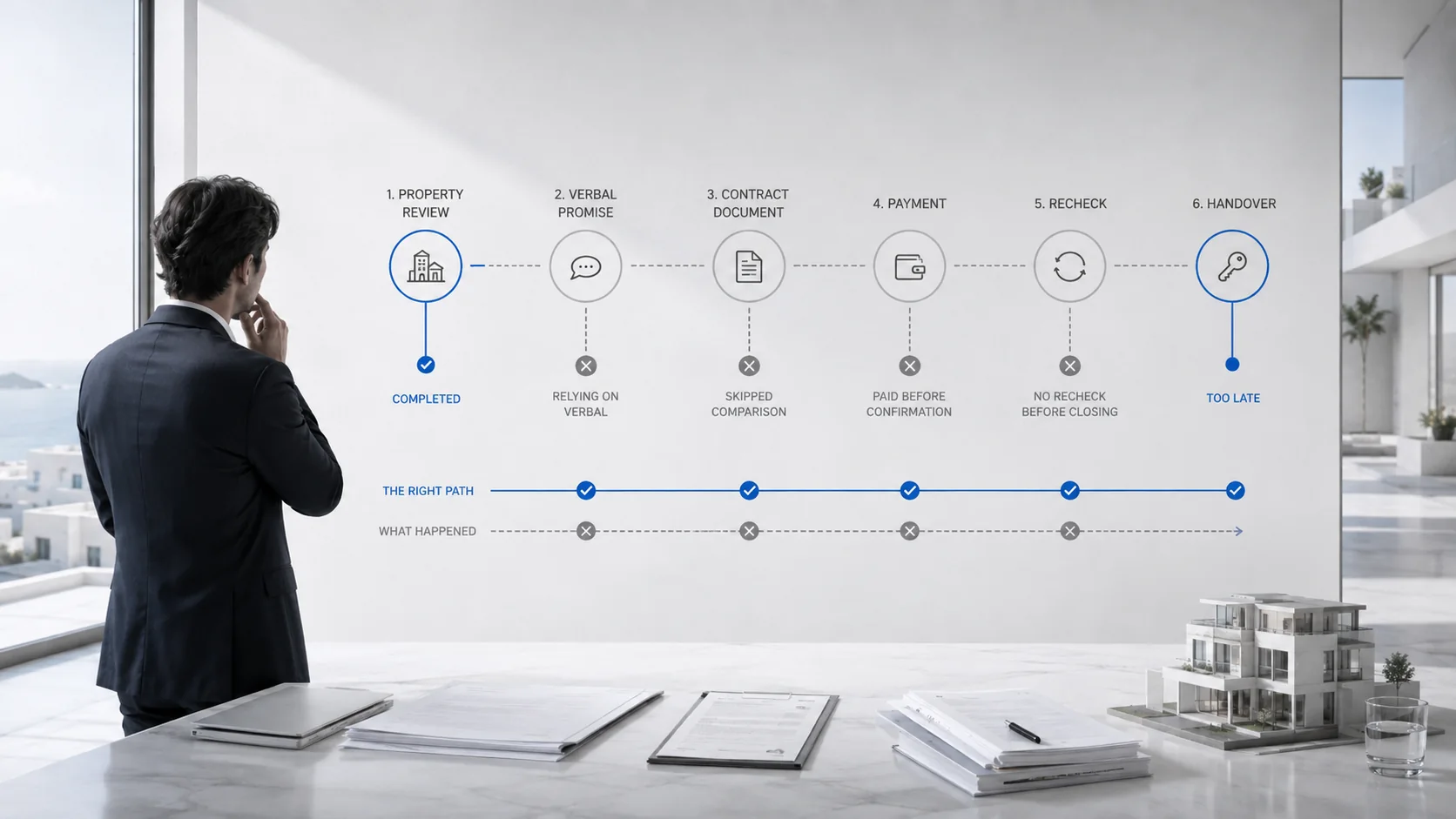
Contract mistakes often begin with skipped checks.
A transaction can go wrong even when the other party is not acting maliciously. Mistakes often begin when the buyer assumes something is probably correct or believes that one earlier check is enough. This section focuses on omissions and assumptions created by the buyer, not external fraud signals.
WHY MISTAKES HAPPEN · Why mistakes happen
Small omissions create major mistakes.
In building transactions, mistakes are often created not by one dramatic error but by a chain of small omissions: accepting an explanation without checking it, leaving verbal agreements undocumented, or failing to recheck before closing. The six patterns below focus on mistakes the buyer can actively control.
01ASSUMPTION · Assumptions
Explanation becomes assumed fact.
The seller or broker may be telling the truth. The mistake is treating an explanation as if it has already been verified.
The more important a statement is— such as 'the parking is included, ' 'the tenant will leave, ' or 'this right will be released before closing'.
01Explanation
02Assumption
03Check skipped
04Condition omitted
02DOCUMENT · Documents
Document received, checks skipped.
Receiving ownership or tenancy records does not complete the review. You still need to know what the document proves, what date it reflects, and whether it matches the current situation.
Outdated records or partial pages can create false confidence if they are treated as current and complete.
01Document received
02Content not checked
03Reference date missed
04Does not match current state
03VERBAL · Verbal Agreements
Important promises stay verbal.
When both sides feel they have discussed everything clearly, documentation is often skipped. But over time, memories can differ about scope, deadline, and responsibility.
Repairs, vacancy, facility handover, and release of rights should not remain as 'we both know what we agreed.' They should be recorded in terms that can be checked later.
01Verbal agreement
02Memory reliance
03Different interpretations
04Dispute
04MONEY · Payment
Paying before conditions are checked.
A date in the contract can create pressure to transfer funds simply because the calendar says so. But a payment date and the conditions for payment are not the same thing.
If repairs, releases, or document delivery must occur before payment, verify those conditions before allowing the calendar to trigger the transfer.
01Payment date
02Conditions unchecked
03Payment first
04Less leverage
05RECHECK · Recheck
One check is treated as permanent.
Even if rights and tenancy were reviewed carefully before signing, there is no guarantee they remain unchanged until closing.
A signing-date check tells you what was true then. A pre-closing recheck answers a different question: whether it is still appropriate to pay now.
01Checked before signing
02Time passes
03Facts can change
04Recheck skipped
06HANDOVER · Handover
Treating final payment as completion.
Payment and legal title transfer are important, but operating the building also requires keys, tenancy records, facility information, and management materials.
Even if the legal transfer is complete, missing operational information can create immediate problems with tenants, maintenance, and expense settlement.
01Final payment
02Legal transfer
03Operating records missing
04Post-acquisition confusion
MISTAKE SCAN · Mistake-pattern scan
Fix the order to block mistakes.
Read what was skipped in each MISTAKE, understand the cause through WHY IT HAPPENS, and insert the BLOCK IT action into the actual transaction sequence.
01
ASSUMPTION
Assumptions
MISTAKE 01
Assuming visible facilities are included.
WHY IT HAPPENSBecause visible use is mistaken for ownership and transfer scope.
BLOCK ITList important facilities and confirm ownership, inclusion, and removal status in the contract or an attachment.
MISTAKE 02
Assuming tenant move-out goes to plan.
WHY IT HAPPENSBecause a stated move-out plan is treated as if vacant possession has already been completed.
BLOCK ITVerify the tenant, deadline, deposit settlement, and actual vacant-possession condition separately.
MISTAKE 03
Assuming rights clear automatically.
WHY IT HAPPENSBecause a promise to release is confused with actual release readiness.
BLOCK ITRecheck the right to be released, payoff amount, required documents, and execution sequence before closing.
MISTAKE 04
Assuming 'common practice' is enough.
WHY IT HAPPENSBecause 'custom' is allowed to substitute for evidence specific to the current transaction.
BLOCK ITVerify the authority, ownership, use, or payment basis that actually applies to this transaction.
02
DOCUMENT
Documents
MISTAKE 01
Ignoring the document date.
WHY IT HAPPENSBecause outdated information can be mistaken for the current situation.
BLOCK ITMark the issue or reference date for key records and recheck freshness before signing and closing.
MISTAKE 02
Reading the title, not the details.
WHY IT HAPPENSBecause the limits of what the document proves are not distinguished.
BLOCK ITRead and check the key fields that matter to the decision, such as owner, area, rights, and reference date.
MISTAKE 03
Not comparing documents.
WHY IT HAPPENSBecause each record can look reasonable on its own while describing different facts.
BLOCK ITCross-check key information across ownership records, official property records, leases, the site, and the contract.
MISTAKE 04
Using copies instead of source records.
WHY IT HAPPENSBecause omitted content, date context, or alterations may be difficult to detect.
BLOCK ITUse source records or independently verifiable official records for material decisions whenever possible.
03
VERBAL
Verbal Agreements
MISTAKE 01
Leaving repair promises verbal.
WHY IT HAPPENSBecause memories can differ about repair scope, completion standard, and deadline.
BLOCK ITRecord the location, work scope, responsibility, deadline, and verification method as a contract condition.
MISTAKE 02
Keeping included facilities verbal.
WHY IT HAPPENSBecause the parties may later disagree about whether an item was excluded.
BLOCK ITList important facilities and fixtures as included, excluded, or to be removed, and link them to photos.
MISTAKE 03
Not documenting vacancy promises.
WHY IT HAPPENSBecause the occupant, timing, and deposit settlement can become unclear.
BLOCK ITDocument who must deliver what condition by when, and what happens if it is not completed.
MISTAKE 04
Leaving out 'known' terms.
WHY IT HAPPENSBecause shared understanding is not the same as a term that can be verified later.
BLOCK ITRecord agreements affecting payment, handover, or rights in the contract, special conditions, or attachments.
04
MONEY
Payment
MISTAKE 01
Checking the date, not the conditions.
WHY IT HAPPENSBecause a calendar date is mistaken for proof that the transaction is ready for payment.
BLOCK ITCheck the preconditions and evidence of completion for each payment stage before transferring funds.
MISTAKE 02
Using only the contract balance.
WHY IT HAPPENSBecause assumed deposits, adjustments, and payoff amounts can be missed.
BLOCK ITPrepare a separate final reconciliation that includes prior payments, assumed amounts, adjustments, and payoff figures.
MISTAKE 03
Not rechecking the transfer account.
WHY IT HAPPENSBecause account information may have changed or been communicated incorrectly after signing.
BLOCK ITImmediately before transfer, compare the contract, reconciliation, and account basis and reconfirm both recipient and amount.
MISTAKE 04
Paying despite an unresolved problem.
WHY IT HAPPENSBecause meeting the schedule is given priority over verification.
BLOCK ITIf a required condition is unresolved, hold payment and first consider resolution, professional review, or schedule adjustment.
05
RECHECK
Recheck
MISTAKE 01
Skipping the final rights recheck.
WHY IT HAPPENSBecause new rights or encumbrances can arise after signing.
BLOCK ITCompare the latest rights status with the signing-date baseline immediately before closing.
MISTAKE 02
Skipping the tenancy update.
WHY IT HAPPENSBecause new leases, move-outs, or deposit changes can alter the assumed amount.
BLOCK ITRecompile the latest lease and deposit information for each tenant before closing.
MISTAKE 03
Accepting completion without proof.
WHY IT HAPPENSBecause claimed performance and actual completion can be different.
BLOCK ITVerify repairs, vacancy, document delivery, and rights release against the contract's completion standard and evidence.
MISTAKE 04
Using an outdated closing calculation.
WHY IT HAPPENSBecause leases, utilities, service charges, and payoff figures can change.
BLOCK ITRebuild the closing worksheet using current figures and compare it with the other party's calculation.
06
HANDOVER
Handover
MISTAKE 01
Treating keys as full handover.
WHY IT HAPPENSBecause actual operation requires tenancy, facility, and management information in addition to physical access.
BLOCK ITUse a handover list covering keys, access, leases, facilities, management records, and contacts.
MISTAKE 02
Missing tenant and management contacts.
WHY IT HAPPENSBecause rent collection, complaints, and facility response can be disrupted immediately after acquisition.
BLOCK ITTake over tenant, property-management, and maintenance contacts and relevant accounts.
MISTAKE 03
Missing facility operating records.
WHY IT HAPPENSBecause responsibility, contractual relationships, and maintenance methods can be difficult to determine when a problem occurs.
BLOCK ITCollect manuals, warranties, rental agreements, and maintenance records for each major facility.
MISTAKE 04
Leaving post-closing tasks to memory.
WHY IT HAPPENSBecause statutory deadlines or assigned tasks can be missed.
BLOCK ITTrack post-closing work in a separate list with responsible person, deadline, and completion evidence.
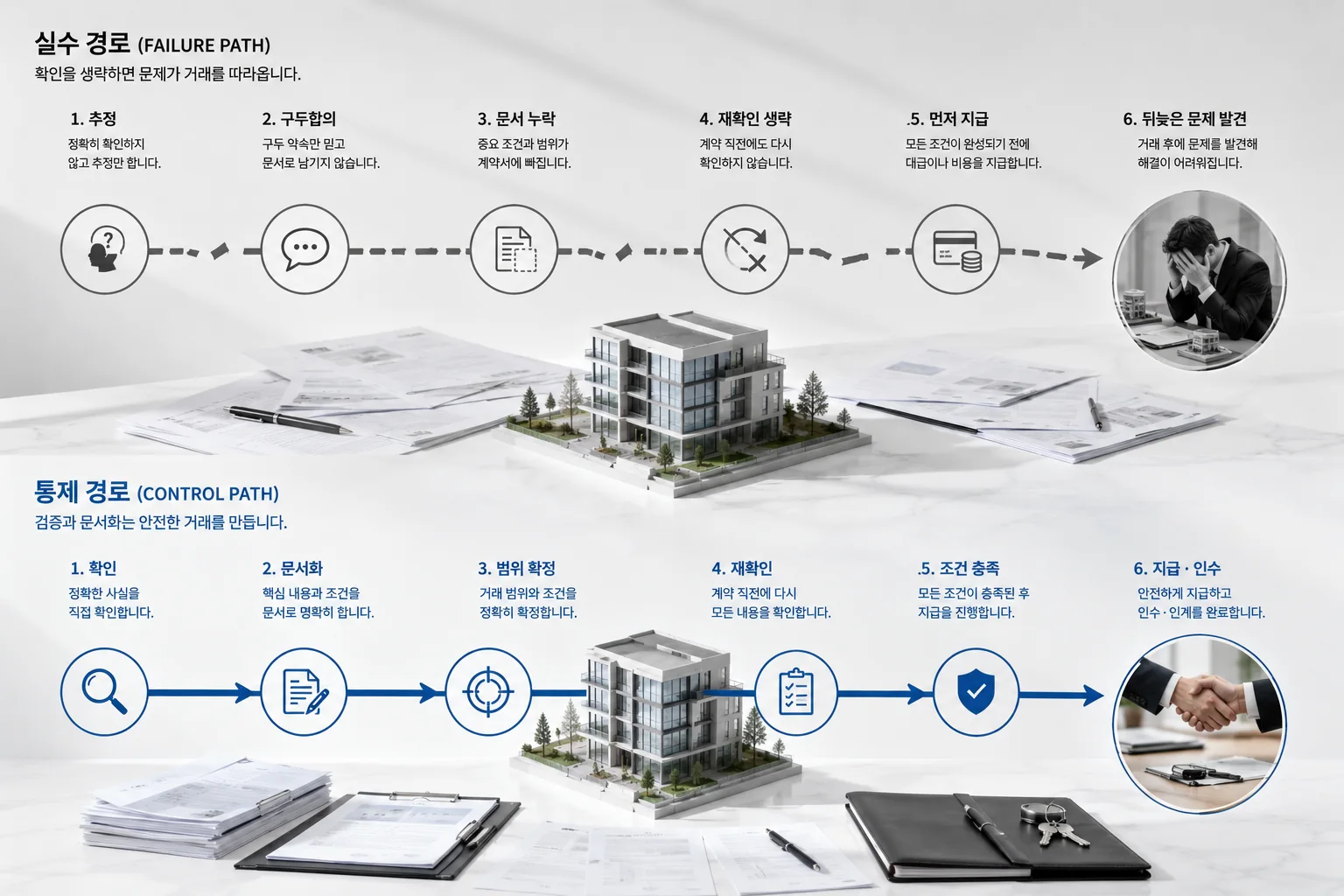
FAILURE PATH · How small omissions grow
Small omissions compound.
FAILURE PATH · How small omissions grow
01ASSUME
02VERBAL AGREEMENT
03SKIP VERIFICATION
04PAY FIRST
05DISCOVER LATE
CONTROL PATH · A safer control sequence
01VERIFY
02DOCUMENT
03RECHECK
04CONDITIONS MET
05PAY & TAKE OVER
No process eliminates every possible mistake. But controllable errors can be reduced substantially by refusing to guess important facts, documenting agreements, rechecking conditions before payment, and completing the actual handover.
CORE PRINCIPLE · Core principle
Stop repeating small omissions.
This guide provides general educational information. Legal, tax, registration and transaction decisions can vary by jurisdiction and deal structure.